Peristaltic Pump vs Syringe Pump: Which Is Better for Precision Dosing Applications?
- June 27, 2026
- ENQUIRE NOW
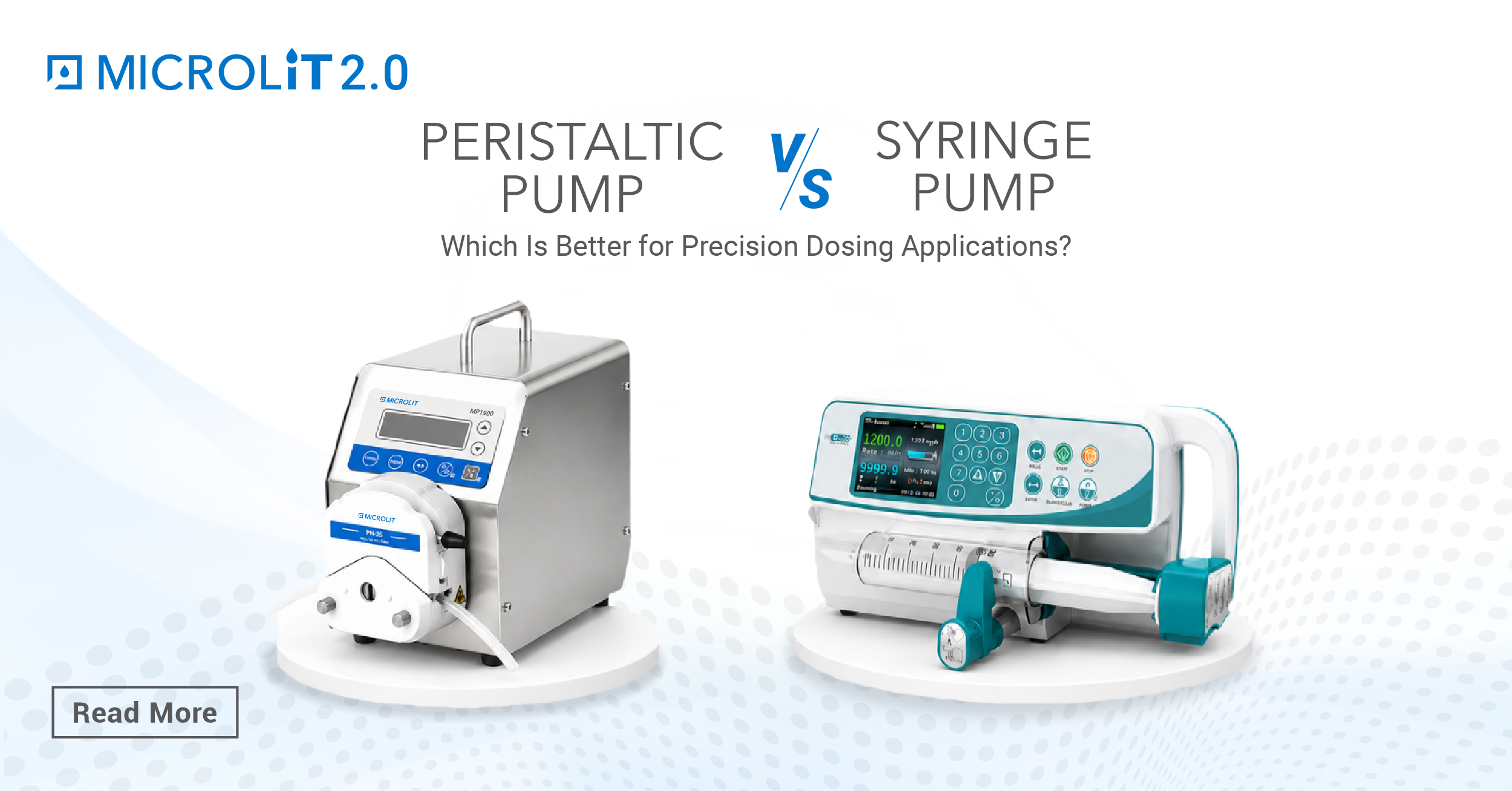
Precision fluid dosing is a critical requirement across pharmaceuticals, biotechnology, diagnostics, analytical laboratories, chemical processing, and research applications. Whether dispensing reagents, transferring cell culture media, dosing chemicals, or performing automated laboratory workflows, selecting the right pump technology can significantly impact accuracy, efficiency, and process reliability.
Among the most commonly used fluid handling technologies are peristaltic pumps and syringe pumps. Both are designed to deliver controlled volumes of liquid, yet they differ significantly in their operating capabilities, flow characteristics, maintenance requirements, and suitability for various applications.
Understanding these differences can help laboratories and industries select the most appropriate solution for their specific dosing needs.
Understanding Precision Dosing Requirements
Before comparing technologies, it is important to understand what defines a successful dosing system.
Key requirements typically include:
- Accurate volume delivery
- Repeatable performance
- Minimal contamination risk
- Compatibility with various fluids
- Ease of operation
- Reliable long-term performance
- Scalability for different workflows
The ideal pump should meet these requirements while minimizing maintenance and operational complexity.
Peristaltic Pumps for Precision Dosing
Peristaltic pumps have become increasingly popular in laboratories and industrial settings due to their versatility and contamination-free fluid handling capabilities.
Key Advantages
-
Contamination-Free Fluid Path
One of the biggest advantages of peristaltic pumps is that the fluid only comes into contact with the tubing.
This offers several benefits:
- Reduced contamination risk
- Easy sterilization
- No cross-contamination
- Ideal for sensitive biological samples
This is particularly important in pharmaceutical and biotechnology environments where sterility is critical.
-
Continuous Flow Operation
Peristaltic pumps are designed to provide continuous fluid transfer, making them highly suitable for:
- Long-duration dosing
- Media feeding
- Chemical transfer
- Process automation
- Bioreactor applications
Unlike syringe pumps, they do not require frequent refilling during extended operations.
-
Excellent Fluid Compatibility
Peristaltic pumps can handle:
- Corrosive chemicals
- Acids and alkalis
- Biological fluids
- Viscous liquids
- Abrasive slurries
- Shear-sensitive samples
Changing fluid compatibility often requires only a tubing change rather than replacing pump components.
-
Low Maintenance
Since there are no valves, seals, or wetted mechanical parts, maintenance is relatively simple.
Routine maintenance generally involves:
- Tubing inspection
- Tubing replacement
- Basic cleaning
This reduces downtime and lowers operating costs.
-
Dry-Run Capability
Peristaltic pumps can safely operate without fluid for short periods, reducing the risk of equipment damage during operation.
Syringe Pumps for Precision Dosing
Syringe pumps are commonly used in applications requiring extremely low flow rates and highly controlled dispensing volumes.
Key Advantages
-
Exceptional Microfluidic Precision
Syringe pumps excel in applications involving:
- Nanoliter dosing
- Microliter dosing
- Microfluidics
- Analytical chemistry
- Controlled laboratory experiments
For very small volume dispensing, syringe pumps often provide superior resolution.
-
Stable Low Flow Rates
Syringe pumps are capable of delivering highly controlled low flow rates over short periods.
This makes them ideal for:
- Drug delivery studies
- Analytical instrumentation
- Controlled infusion experiments
-
High Accuracy for Fixed Volumes
When dispensing a predefined volume from a syringe, these systems can provide excellent accuracy and repeatability.
Limitations of Syringe Pumps
Despite their strengths, syringe pumps have several limitations that can restrict their use in larger-scale or continuous applications.
Limited Volume Capacity
The syringe size determines the maximum fluid volume available for dispensing.
This means:
- Frequent refilling may be required
- Continuous processes become difficult
- Operator intervention increases
Higher Maintenance
Syringes, plungers, seals, and related components require regular maintenance and replacement.
Limited Scalability
For larger flow rates or industrial processes, syringe pumps may not be practical due to volume restrictions.
Reduced Flexibility
Changing fluids often requires:
- Cleaning the syringe
- Replacing components
- Recalibration
This can increase downtime between applications.
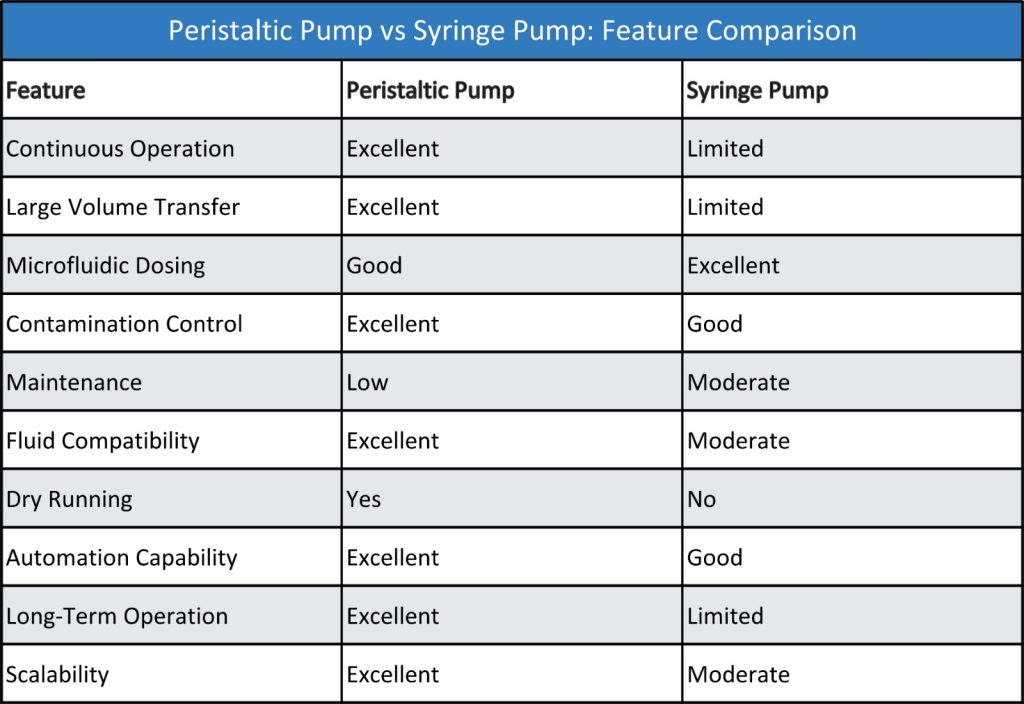
Peristaltic Pump vs Syringe Pump: Feature Comparison
Which Pump Is Better for Pharmaceutical Applications?
Pharmaceutical manufacturing often requires:
- Accurate dosing
- Sterile fluid transfer
- Process scalability
- Regulatory compliance
For applications such as:
- Media transfer
- Vaccine production
- API manufacturing
- Buffer preparation
- Filling operations
Peristaltic pumps are generally preferred because they offer contamination-free fluid handling and continuous operation.
Syringe pumps are more commonly used during:
- Drug development
- Analytical testing
- Controlled laboratory studies
where very small volumes are required.
Which Pump Is Better for Biotechnology Applications?
Biotechnology workflows often involve sensitive biological materials that require gentle handling.
Examples include:
- Cell cultures
- Proteins
- Enzymes
- Biological reagents
Peristaltic pumps are particularly advantageous because they provide:
- Gentle fluid transfer
- Continuous feeding
- Minimal contamination risk
- Easy sterilization
These characteristics make them ideal for bioprocessing and fermentation applications.
Which Pump Is Better for Laboratory Automation?
Modern laboratories increasingly depend on automation to improve productivity and reduce human error.
Automation systems require pumps that offer:
- Programmable operation
- Consistent performance
- Long-duration operation
- Minimal intervention
Peristaltic pumps generally outperform syringe pumps in automated workflows because they can run continuously without frequent refilling.
Applications include:
- Automated dispensing
- Sample preparation
- Reagent delivery
- Instrument integration
Cost Considerations
When evaluating total cost of ownership, buyers should consider:
Initial Equipment Cost
Both technologies are available across a wide range of price points.
Maintenance Cost
Peristaltic pumps generally have lower maintenance requirements.
Consumables Cost
Syringe pumps require ongoing replacement of syringes and related components.
Downtime Cost
Frequent refilling and maintenance can increase operational interruptions when using syringe systems.
For continuous industrial or laboratory operations, peristaltic pumps often offer a lower overall cost of ownership.
Why More Laboratories Are Choosing Peristaltic Pumps
As laboratories become increasingly automated and throughput demands rise, many organizations are shifting toward peristaltic pump technology because of its:
- Continuous operation
- Ease of maintenance
- Broad fluid compatibility
- Scalability
- Automation readiness
- Contamination-free fluid path
These advantages make peristaltic pumps suitable for both research environments and industrial
Conclusion
Both peristaltic pumps and syringe pumps have important roles in precision dosing applications. Syringe pumps excel in ultra-low-volume dispensing and microfluidic applications, while peristaltic pumps offer greater versatility, continuous operation, lower maintenance, and superior scalability.
For organizations requiring contamination-free fluid transfer, long-duration operation, automation compatibility, and reliable dosing across a wide range of applications, peristaltic pumps are often the preferred choice.
Microlit Peristaltic Pumps combine precision, durability, and ease of use, making them an ideal solution for modern laboratories and industries seeking accurate and efficient fluid handling.