Carousel Pipette Stand vs Wall-Mounted Pipette Holder: Which Is Better?
- September 25, 2026
- ENQUIRE NOW
In a busy laboratory, pipettes are among the most frequently handled instruments. They move from one workstation to another, are used repeatedly throughout the day, and need to be stored properly when not in use. While pipette storage may seem like a small consideration, the right holder can improve workspace organization, accessibility, instrument safety, and day-to-day efficiency.
Two common storage solutions are carousel pipette stands and wall-mounted pipette holders. Both serve the same fundamental purpose keeping pipettes upright, organized, and readily accessible but they offer very different experiences.
So, which one is better?
The answer depends on your laboratory layout, workflow, number of pipettes, and how often your instruments need to be moved. Let’s compare the two and look at how the Microlit Faveo Carousel Pipette Stand fits into this equation.
Why Proper Pipette Storage Matters
A micropipette is a precision liquid-handling instrument, and how it is stored between uses matters. Pipettes should ideally be kept upright and in a clean, dry environment to help protect them from contamination and unnecessary mechanical stress. Microlit also recommends proper storage as an important part of micropipette care.
Leaving pipettes flat on a workbench can occupy valuable space and may increase the possibility of accidental knocks, contamination, or damage. A dedicated pipette holder provides a defined storage location and makes it easier for users to develop consistent laboratory practices.
But should that holder sit on the bench or be mounted on the wall?
Carousel Pipette Stand: Flexible and Accessible Storage
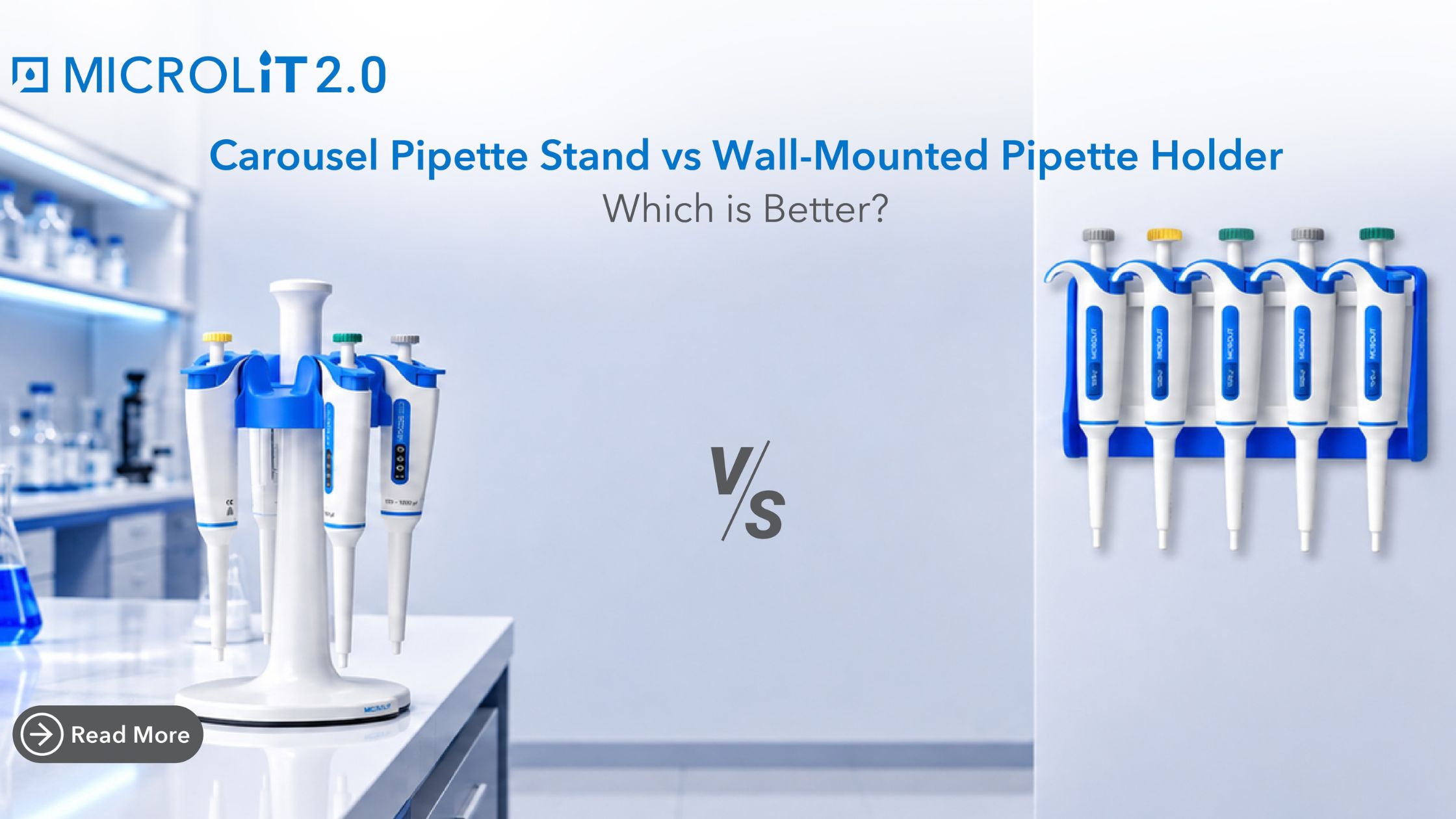
A carousel pipette stand is designed to keep several pipettes upright while allowing users to access them from a central location.
One example is the Microlit Faveo Carousel Pipette Stand, designed to hold up to six micropipettes. Its rotating design allows users to turn the stand and quickly access the required pipette. It can accommodate up to six single-channel pipettes, three multichannel pipettes, or a combination of three single-channel and three multichannel pipettes.
- 360° Accessibility
One of the biggest advantages of a carousel stand is accessibility.
With a 360° rotating head, the user can rotate the stand to bring the required pipette closer rather than reaching across the workbench or searching through several instruments. This can be particularly convenient in laboratories where multiple pipettes are used throughout the day.
- Stores Different Types of Pipettes
Laboratories often use both single-channel and multichannel micropipettes. The Microlit Faveo is designed to accommodate both, providing flexibility for laboratories with different pipetting requirements.
- Easy One-Handed Access
Its stable base is designed to support single-handed placement and removal of pipettes. This can be useful when the other hand is occupied with a sample, tube, plate, or another laboratory task.
- Portable and Space-Conscious
Unlike a wall-mounted holder, a carousel stand does not require permanent installation. The Microlit Faveo is lightweight and compact, allowing it to be placed where it is most convenient for the user. Its listed dimensions are approximately 323 mm in height with a 195 mm base diameter.
- Easy to Clean
Laboratory storage accessories should also be easy to maintain. Microlit Faveo is made from polypropylene and can be cleaned using soap and water or commonly used laboratory disinfectants. It is not autoclavable, so users should follow appropriate cleaning and care practices.
Wall-Mounted Pipette Holder: Maximum Use of Bench Space
A wall-mounted pipette holder takes a different approach. Instead of occupying space on the workbench, it is fixed to a wall, cabinet, or other suitable vertical surface.
This can be particularly useful in laboratories where bench space is limited.
Because the holder is positioned vertically, the work surface beneath it remains available for instruments, samples, tip boxes, notebooks, or other laboratory equipment.
A wall-mounted holder can also provide a clearly defined storage location. In laboratories where instruments are assigned to particular workstations, fixed storage can help establish an organized workflow.
However, its permanent nature can also be a limitation. Once installed, the holder generally remains in one location. If pipettes need to move between different benches, rooms, biosafety cabinets, or work areas, users may need to remove the instruments from the holder and carry them separately.
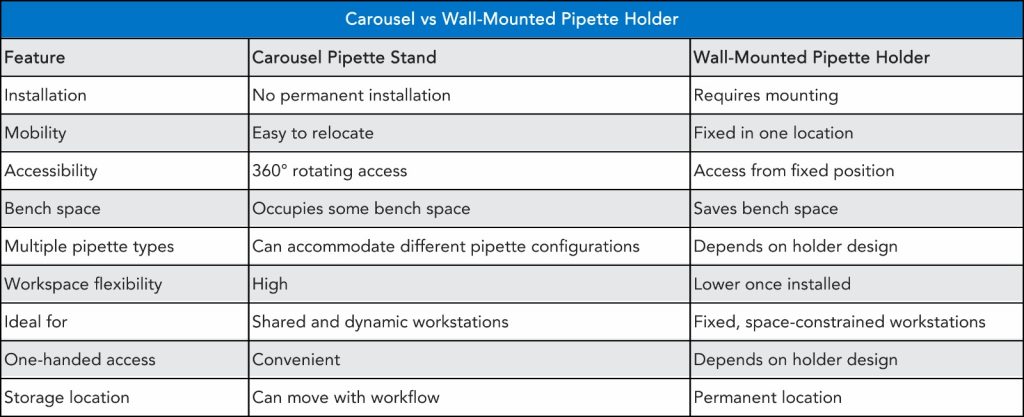
Carousel vs Wall-Mounted Pipette Holder
So, Which One Is Better?
There is no universal answer.
A wall-mounted pipette holder can be a practical choice when your laboratory has limited bench space and pipettes are normally used at one fixed workstation.
A carousel stand, on the other hand, can be more suitable when accessibility, flexibility, and portability are important. It allows the storage unit itself to move with the workflow rather than forcing the workflow to remain around a fixed storage point.
For laboratories using several types of micropipettes, the Microlit Faveo offers a particularly flexible arrangement. Its ability to hold single-channel and multichannel pipettes, combined with its rotating head and stable base, makes it suitable for shared laboratory workstations.
Microlit has also recommended its Faveo carousel stand as a storage solution for micropipettes, reinforcing the importance of keeping pipettes properly stored when they are not in use.
Choosing the Right Pipette Storage for Your Laboratory
Before choosing a pipette holder, consider four simple questions:
- How much bench space do you have?
If every centimetre matters, a wall-mounted option may help free up valuable working space. - Do pipettes move between workstations?
If your team frequently moves between benches or applications, a portable carousel stand offers greater flexibility. - How many and what types of pipettes do you use?
If your laboratory uses both single-channel and multichannel pipettes, consider a holder that can accommodate both. - How important is quick access?
For high-frequency pipetting workflows, a rotating stand can make it convenient to locate and pick up the required pipette.
The Bottom Line
Both carousel pipette stands and wall-mounted pipette holders have a place in modern laboratories. A wall-mounted holder can maximize vertical space and provide fixed, organized storage, while a carousel stand provides mobility, flexibility, and easy access.
The Microlit Faveo Carousel Pipette Stand is designed around convenience: it can hold up to six micropipettes, accommodates single- and multichannel instruments, features a 360° rotating head, has a stable base for one-handed operation, and is lightweight enough to be positioned wherever the workflow demands.
Ultimately, the right choice isn’t simply about choosing the most advanced-looking holder. It is about choosing the storage solution that fits the way your laboratory actually works.
For dynamic laboratories where pipettes are frequently accessed, shared, and moved, a carousel stand such as Microlit Faveo can bring storage, accessibility, and flexibility together in one compact solution.