Electronic vs Manual Pipettes for High-Throughput Laboratory Workflows
- October 12, 2026
- ENQUIRE NOW
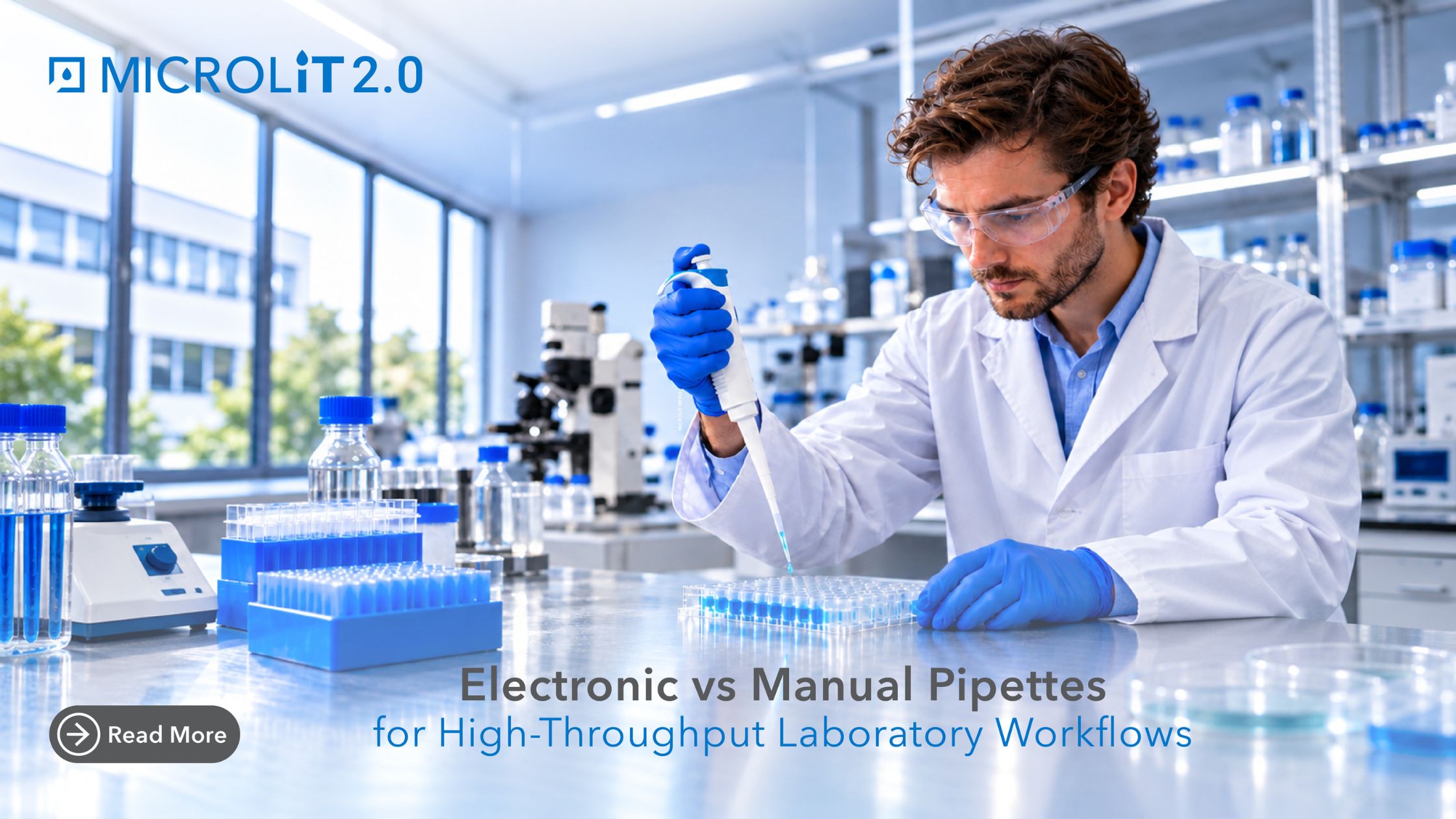
High-throughput laboratories operate in an environment where speed, consistency, accuracy, and productivity are equally important. Whether processing hundreds of samples for molecular biology, clinical diagnostics, pharmaceutical research, genomics, cell culture, or quality control, laboratories need liquid-handling instruments that can keep pace with demanding workflows.
Pipettes remain at the heart of many of these processes. However, laboratories often face an important question: Should high-throughput workflows use electronic pipettes or manual pipettes?
Both have distinct advantages. Manual pipettes provide simplicity, control, and flexibility, while electronic pipettes can automate repetitive pipetting steps and help standardize operator technique. The right choice depends on sample volume, throughput, workflow complexity, application, and laboratory requirements.
Let’s compare electronic and manual pipettes to understand which option is better suited to high-throughput laboratory workflows.
What Are Manual Pipettes?
Manual pipettes use a mechanical piston mechanism controlled by the operator. The user typically sets the required volume, attaches a pipette tip, presses the plunger, aspirates the liquid, and dispenses it into the required vessel.
Manual micropipettes are widely used because they are straightforward, versatile, and suitable for a broad range of everyday laboratory applications.
They are available in multiple configurations, including:
- Fixed-volume pipettes
- Variable-volume pipettes
- Single-channel pipettes
- Multichannel pipettes
For routine sample preparation, reagent transfer, dilution, and other general laboratory procedures, manual pipettes continue to provide a practical liquid-handling solution.
What Are Electronic Pipettes?
Electronic pipettes use electronically controlled piston movement to perform aspiration and dispensing operations. Instead of manually controlling every plunger movement, the user can select the required operating parameters and allow the pipette to execute liquid-handling steps electronically.
Depending on the model, electronic pipettes may offer multiple operating modes for applications such as pipetting, repeated dispensing, mixing, dilution, sequential dispensing, and other repetitive workflows.
Electronic control can be particularly valuable in high-throughput environments because it reduces dependence on repetitive manual plunger movements and can help create more standardized liquid-handling operations.
Electronic vs Manual Pipettes: What Is the Main Difference?
The fundamental difference is how the piston movement is controlled.
With a manual pipette, aspiration and dispensing depend significantly on the user’s physical operation of the plunger. With an electronic pipette, piston movement is controlled electronically according to selected parameters.
This distinction becomes particularly important as sample numbers increase.
Processing 10 samples manually may be straightforward. Processing hundreds of samples, multiple microplates, or repetitive dispensing cycles can place substantially greater demands on both the operator and the workflow.
This is where electronic pipettes can offer significant advantages.
-
Speed and Productivity
High-throughput laboratories need to process large numbers of samples efficiently.
Manual pipettes can be highly efficient for individual transfers and smaller batches. Experienced users can work quickly, particularly when performing familiar procedures.
However, repetitive operations involving hundreds of aspiration and dispensing cycles can become time-consuming.
Electronic pipettes can simplify repetitive operations by automating piston movement and, where supported, offering functions such as multi-dispensing. Instead of repeating the complete aspiration-dispensing cycle for every destination, an operator may be able to aspirate a larger volume and dispense defined aliquots sequentially.
For workflows involving microplates or repetitive reagent distribution, this can improve overall efficiency.
High-throughput advantage: Electronic pipettes
-
Consistency Between Pipetting Cycles
Consistency is critical when processing large sample batches.
With manual pipetting, performance can be influenced by factors such as plunger speed, aspiration technique, dispensing technique, operator experience, and fatigue.
A trained operator can achieve excellent results with a manual pipette. However, maintaining exactly the same plunger movement across hundreds of repetitions can become challenging.
Electronic pipettes standardize piston movement. Once appropriate settings are selected, aspiration and dispensing can be performed at controlled speeds, reducing some sources of operator-dependent variation.
This can be especially beneficial where consistent pipetting conditions are required across a large batch.
Consistency advantage: Electronic pipettes
-
Ergonomics and Operator Fatigue
Ergonomics should be a major consideration in high-throughput laboratories.
Repetitive pipetting may require hundreds or even thousands of plunger operations during a working session. Over extended periods, repetitive thumb and hand movements can contribute to operator discomfort and fatigue.
Modern manual pipettes are increasingly designed with ergonomic features such as reduced operating forces, comfortable grips, and lightweight construction.
Electronic pipettes can further reduce repetitive manual plunger operation because aspiration and dispensing are motor-driven.
For laboratories where operators spend substantial portions of the day pipetting, this reduction in repetitive manual action can be a significant advantage.
Ergonomic advantage for highly repetitive work: Electronic pipettes
-
Flexibility and Ease of Use
Manual pipettes offer exceptional simplicity.
Select the volume, attach the tip, and begin pipetting. They generally require minimal setup and no battery charging.
This makes them highly convenient for quick transfers, routine experiments, educational laboratories, and workflows where operators frequently move between different tasks.
Electronic pipettes typically require greater familiarity with their controls and operating modes. However, once users are properly trained, programmable or selectable modes can simplify more complex workflows.
Therefore, the choice depends on the application.
For straightforward transfers, manual pipettes may be more convenient. For repetitive or multi-step procedures, electronic pipettes can provide greater workflow flexibility.
-
Multichannel Pipetting for Microplates
Microplates are common in high-throughput laboratories.
Applications such as ELISA, PCR, cell-based assays, screening, genomics, and drug discovery frequently involve 96-well or other multiwell formats.
Using a single-channel pipette to fill every well individually can significantly increase processing time.
Multichannel pipettes allow multiple wells to be addressed simultaneously. Both manual and electronic multichannel pipettes can therefore substantially improve productivity.
Electronic multichannel pipettes add electronic piston control to this advantage, making them particularly useful for repetitive plate-based operations.
Some electronic systems also provide adjustable or variable tip spacing, which can be valuable when transferring liquids between laboratory vessels with different spacing.
-
Accuracy and Precision
Both high-quality manual and electronic pipettes can provide excellent accuracy and precision when correctly selected, maintained, calibrated, and operated.
It is important not to assume that electronic automatically means more accurate.
Manual pipettes can achieve highly reliable results in the hands of trained users. Electronic pipettes, however, can help reduce certain variations associated with manual plunger movement.
Regardless of pipette type, laboratories should follow proper pipetting techniques and appropriate calibration and performance-check procedures. Pipette performance should also comply with applicable specifications and relevant standards such as ISO 8655.
-
Cost and Return on Investment
Manual pipettes generally have a lower initial acquisition cost than electronic pipettes.
For laboratories with moderate sample volumes or occasional pipetting requirements, manual pipettes can therefore be highly economical.
Electronic pipettes require a greater initial investment, but purchase price should not be considered in isolation.
In high-throughput environments, laboratories should consider:
Cost per sample, operator time, workflow speed, repetitive workload, throughput, consistency, and overall productivity.
If an electronic pipette enables an operator to process repetitive workflows more efficiently, the productivity benefits may justify the additional investment.
When Should You Choose a Manual Pipette?
A manual pipette may be preferable when:
- Sample throughput is low to moderate.
- Pipetting procedures are straightforward.
- Operators frequently perform individual transfers.
- Budget is an important consideration.
- Portability and simplicity are priorities.
- Electronic operating modes are unnecessary.
For many routine laboratory workflows, a high-quality manual pipette remains an excellent choice.
When Should You Choose an Electronic Pipette?
An electronic pipette may be more suitable when:
- Hundreds of samples are processed regularly.
- Repetitive dispensing is common.
- Microplates form a major part of the workflow.
- Standardized piston movement is desirable.
- Reducing repetitive manual operation is important.
- Multiple liquid-handling modes are required.
- Laboratory productivity is a major priority.
For high-throughput environments, these advantages can make electronic pipettes particularly valuable.
Microlit Solutions for Manual and Electronic Pipetting
Microlit offers a comprehensive range of pipetting solutions for laboratories with varying throughput requirements.
For manual pipetting, the Microlit NERO® and RAMBO ranges provide options across single-channel and multichannel configurations. NERO® also incorporates Microlit technologies such as μAir® and UniCal®, supporting convenient and reliable everyday liquid handling.
For laboratories seeking electronic liquid handling, the Microlit AQUA Multifunctional Electronic Pipette offers multiple operating modes for diverse applications. The AQUA portfolio includes single-channel, 8-channel, and 12-channel electronic pipettes, along with adjustable/variable-spacing multichannel electronic configurations, making the range particularly relevant for high-throughput and plate-based workflows.
Explore the complete range of Microlit micropipettes.
Electronic or Manual: Which Is Better for High Throughput?
There is no single pipette that is ideal for every laboratory workflow.
For routine transfers, smaller batches, and applications requiring maximum simplicity, manual pipettes provide flexibility, reliability, and cost-effectiveness.
As throughput increases, however, the advantages of electronic pipettes become increasingly relevant. Automated piston movement, repetitive dispensing capabilities, multichannel configurations, reduced repetitive manual operation, and greater workflow standardization can help laboratories process large sample volumes more efficiently.
Many high-throughput laboratories may therefore benefit from using both technologies: manual pipettes for routine and flexible tasks and electronic pipettes for repetitive, plate-based, or high-volume workflows.
Ultimately, choosing between manual and electronic pipettes should not simply be about replacing one technology with another. It should be about selecting the right liquid-handling tool for each workflow.
The right pipette can help transform high-throughput pipetting from a repetitive laboratory task into a faster, more consistent, ergonomic, and efficient process.