Peristaltic Pump vs Diaphragm Pump for Laboratory Liquid Transfer
- October 25, 2026
- ENQUIRE NOW
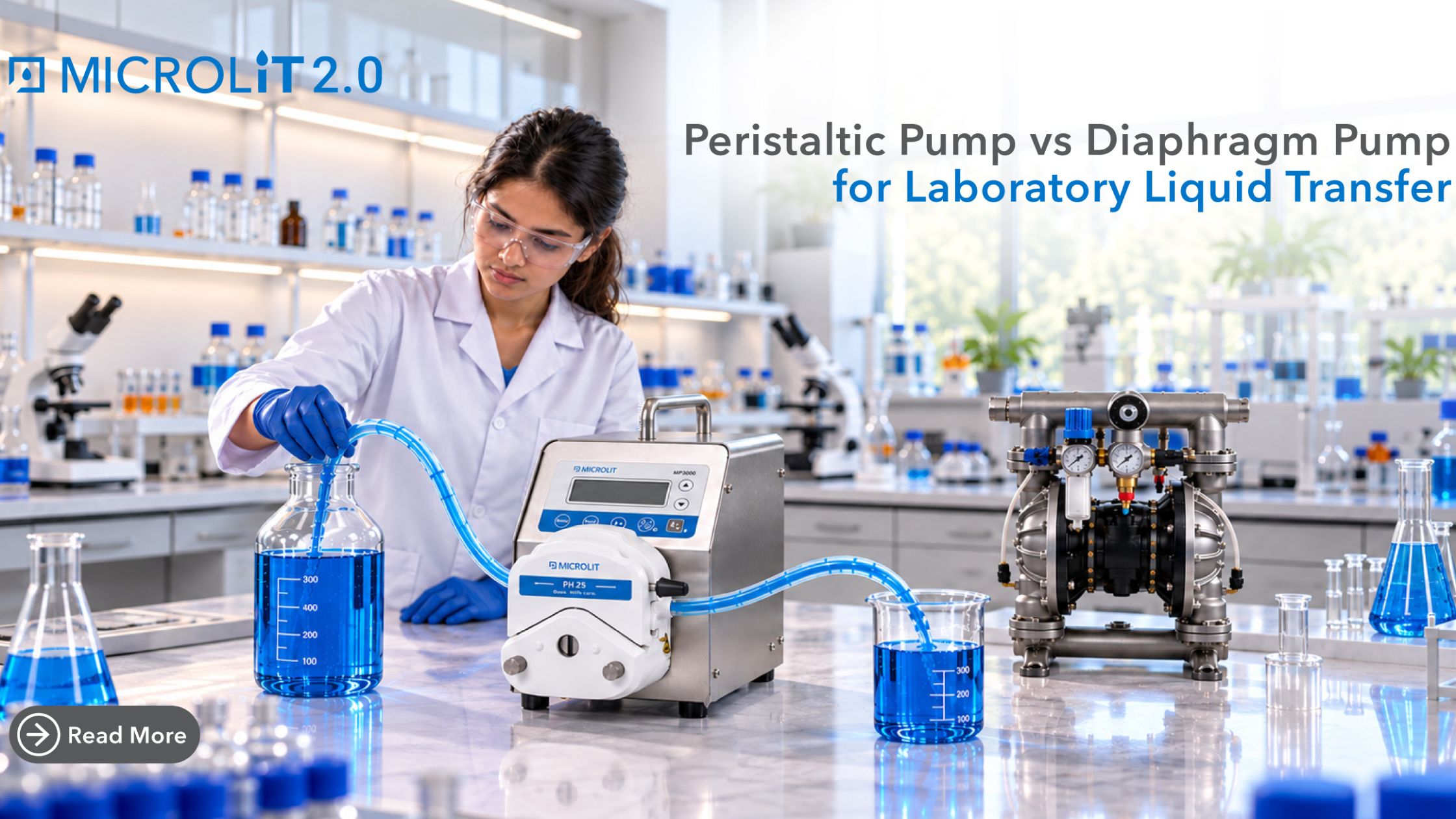
Reliable liquid transfer is essential across research, pharmaceutical, biotechnology, chemical, environmental, food and beverage, and industrial laboratories. Whether transferring buffers, reagents, media, chemicals, or process liquids, choosing the right pumping technology can significantly influence workflow efficiency, contamination control, maintenance requirements and liquid-handling performance.
Two commonly considered technologies are peristaltic pumps and diaphragm pumps. While both can move liquids effectively, they operate using fundamentally different mechanisms and are suited to different applications.
So, when comparing a peristaltic pump vs diaphragm pump for laboratory liquid transfer, which one should you choose?
The answer depends on factors such as the nature of the liquid, required flow rate, pressure requirements, contamination sensitivity, maintenance expectations, and the level of flow control required.
What Is a Peristaltic Pump?
A peristaltic pump transfers liquid through flexible tubing using a series of rollers or shoes. As the pump head rotates, the rollers compress the tubing and push the liquid forward.
Once a roller passes over a section of tubing, the tubing returns toward its original shape, creating suction that draws more liquid into the tube. This continuous compression and release action moves the fluid through the system.
One of the biggest advantages of this mechanism is that the liquid remains inside the tubing. It does not normally come into direct contact with the pump’s internal mechanical components.
This characteristic makes peristaltic pumps particularly useful for laboratory applications where contamination control, cleanliness, and easy fluid-path replacement are important.
What Is a Diaphragm Pump?
A diaphragm pump uses the reciprocating movement of a flexible diaphragm to move liquid.
As the diaphragm moves in one direction, it creates suction and draws liquid into the pump chamber. When it moves in the opposite direction, the liquid is pushed out. Inlet and outlet valves help control the direction of flow.
Diaphragm pumps are available in different configurations and can be used for both liquid and gas handling, depending on their design.
They are particularly useful in applications requiring pressure generation, suction capability, or handling of challenging fluids.
Peristaltic Pump vs Diaphragm Pump: Key Difference
The biggest difference lies in the fluid path.
In a peristaltic pump, the liquid generally contacts only the tubing. In a diaphragm pump, the liquid enters a pump chamber and may come into contact with the diaphragm, valves, and other wetted components.
This difference influences contamination risk, cleaning procedures, chemical compatibility, maintenance, and the ease of switching between liquids.
-
Contamination Control
Contamination is a major concern in biological, pharmaceutical, and research laboratories.
A peristaltic pump provides an important advantage because the pumped liquid remains enclosed within the tubing. If suitable tubing is selected and installed correctly, the pump mechanism itself does not need to contact the liquid.
When changing applications, the tubing can often be replaced to establish a new fluid path.
This makes peristaltic pumping particularly attractive for transferring culture media, buffers, reagents, and other liquids where cleanliness and cross-contamination control are important.
Diaphragm pumps can also be used in clean applications, but their wetted chambers and valves may require more extensive cleaning or flushing between different liquids.
Advantage for isolated fluid paths: Peristaltic pump
-
Flow Control
Laboratory liquid-transfer applications often require controlled flow rather than simply moving a liquid from one container to another.
Peristaltic pumps can provide adjustable flow by controlling the rotational speed of the pump head. Depending on the system, flow can also be modified by changing tubing dimensions and pump-head configurations.
This flexibility makes peristaltic pumps useful for applications such as controlled dispensing, reagent transfer, circulation, feeding, sampling, and continuous liquid delivery.
Diaphragm pumps can also provide controlled flow, although the reciprocating diaphragm action naturally creates a pulsating flow pattern. The extent of pulsation depends on pump design and operating conditions.
For applications where controlled and adjustable low-volume transfer is important, a laboratory peristaltic pump can be highly practical.
-
Pressure Requirements
Pressure is one area where diaphragm pumps can have a significant advantage.
Depending on their design, diaphragm pumps can generate relatively high pressures and strong suction. This makes them useful when liquid needs to be moved against substantial system resistance.
Peristaltic pumps can also generate useful pressure, but their operating limits depend heavily on tubing properties, pump-head design, tubing compression, and other system parameters.
If the primary application involves demanding pressure requirements, a diaphragm pump may be preferable.
If the priority is controlled liquid transfer with an isolated fluid path, a peristaltic pump may be more suitable.
-
Chemical Compatibility
Chemical compatibility should always be evaluated before selecting a laboratory pump.
With a peristaltic pump, compatibility largely depends on the tubing material, because the liquid is typically confined to the tubing.
This offers significant flexibility. Laboratories can select tubing based on the chemical characteristics of the liquid being transferred, provided the tubing is also suitable for the pump.
In diaphragm pumps, users need to consider the compatibility of multiple wetted components, including the diaphragm, valves, seals, and pump chamber.
For laboratories that frequently work with different fluids, the ability to change the tubing can make a peristaltic pump particularly convenient.
-
Maintenance
Maintenance requirements can influence both laboratory productivity and long-term operating costs.
Peristaltic pumps have a relatively straightforward fluid-contact arrangement. Since the liquid remains in the tubing, routine maintenance frequently focuses on inspecting and replacing tubing as it wears.
Tubing is a consumable component because repeated roller compression gradually causes mechanical fatigue.
Diaphragm pumps contain more fluid-contacting components, including valves and diaphragms. These components can wear and may require inspection, cleaning, or replacement depending on the application.
Therefore, while both technologies require maintenance, peristaltic pumps can simplify fluid-path maintenance in many laboratory applications.
-
Handling Sensitive Liquids
Biotechnology and life-science laboratories may need to transfer biologically sensitive materials.
Peristaltic pumps are widely used for applications where an enclosed tubing path is desirable. However, the suitability of any pump for sensitive biological material depends on tubing selection, flow conditions, pump speed, system geometry, and the specific characteristics of the material being handled.
Diaphragm pumps may also be appropriate for certain sensitive fluids, but the repeated diaphragm and valve action should be considered when designing the overall liquid-handling process.
Pump selection should therefore be based on application-specific testing rather than assuming that one technology is universally suitable for every sensitive liquid.
-
Pulsation and Flow Characteristics
Both technologies can produce pulsation.
In a peristaltic pump, pulsation occurs as individual rollers compress and release the tubing. The magnitude of pulsation depends on factors such as the number of rollers, tubing properties, pump speed, and pump-head design.
A diaphragm pump inherently generates pulsation through its suction and discharge cycles.
If highly uniform flow is critical, laboratories may need to consider pump design, operating speed, tubing configuration, dampening systems, or other flow-management techniques regardless of the technology selected.
-
Ease of Changing Between Applications
Laboratories frequently handle multiple liquids during a working day.
With a peristaltic pump, switching applications can be relatively straightforward because the fluid path can often be changed simply by replacing the tubing.
This can reduce cleaning requirements and simplify transitions between different reagents or samples.
With diaphragm pumps, changing fluids may require flushing or cleaning the pump’s wetted components, particularly when cross-contamination must be avoided.
For laboratories that frequently change liquids, this can make peristaltic pumps especially convenient.
Quick Comparison: Peristaltic Pump vs Diaphragm Pump
|
Factor |
Peristaltic Pump |
Diaphragm Pump |
|
Fluid contact |
Primarily tubing | Multiple wetted pump components |
| Contamination control | Excellent fluid-path isolation |
Depends on cleaning and pump design |
|
Flow adjustment |
Easy through speed/tubing selection | Depends on pump configuration |
| High-pressure applications | Application-dependent |
Often well suited |
|
Maintenance |
Mainly tubing-related | Diaphragm, valves and wetted components |
| Changing fluids | Generally simple |
May require flushing/cleaning |
|
Chemical compatibility |
Primarily determined by tubing | Multiple wetted materials must be considered |
| Pulsation | Present |
Present |
|
Laboratory flexibility |
High |
Application-dependent |
Microlit Laboratory Peristaltic Pumps
For laboratories requiring controlled and convenient liquid transfer, Microlit Laboratory Peristaltic Pumps provide solutions for a wide variety of fluid-handling applications.
Microlit’s peristaltic pump portfolio includes Variable Speed and Intelligent Peristaltic Pump configurations, designed to address different laboratory requirements.
These pumps can be considered for applications across pharmaceutical, biotechnology, food and beverage, environmental, chemical, and general laboratory workflows.
Because the liquid travels through tubing, users can select appropriate tubing according to their application and fluid compatibility requirements. This makes the system useful for laboratories seeking flexible liquid transfer while keeping the fluid path separate from the pump mechanism.
Microlit’s intelligent pumping solutions are particularly relevant for applications where controlled dispensing and precise flow management are required, while variable-speed models provide practical control for routine transfer and circulation applications.
Which Pump Should Your Laboratory Choose?
Choosing between a peristaltic and diaphragm pump ultimately depends on the application.
Choose a peristaltic pump when fluid-path isolation, easy tubing replacement, contamination control, adjustable flow, and frequent switching between liquids are priorities.
A diaphragm pump may be preferable when the application requires stronger pressure or suction performance, provided its wetted materials are compatible with the liquid being transferred.
Neither technology is universally better. The best pump is the one whose operating principle matches the laboratory’s specific fluid, flow, pressure, cleanliness, and maintenance requirements.
For laboratories focused on flexible, controlled liquid transfer with an isolated fluid path, peristaltic pumping offers a compelling combination of convenience and versatility.
With its range of laboratory peristaltic pumps, Microlit provides fluid-handling solutions designed to support modern laboratory workflows across research and industrial applications.
The right pump does more than move liquid—it helps make laboratory liquid transfer controlled, repeatable, clean, and efficient.