The Complete Guide to E-Dispensers: Types, Benefits, and Applications in Modern Laboratories
- April 7, 2026
- ENQUIRE NOW
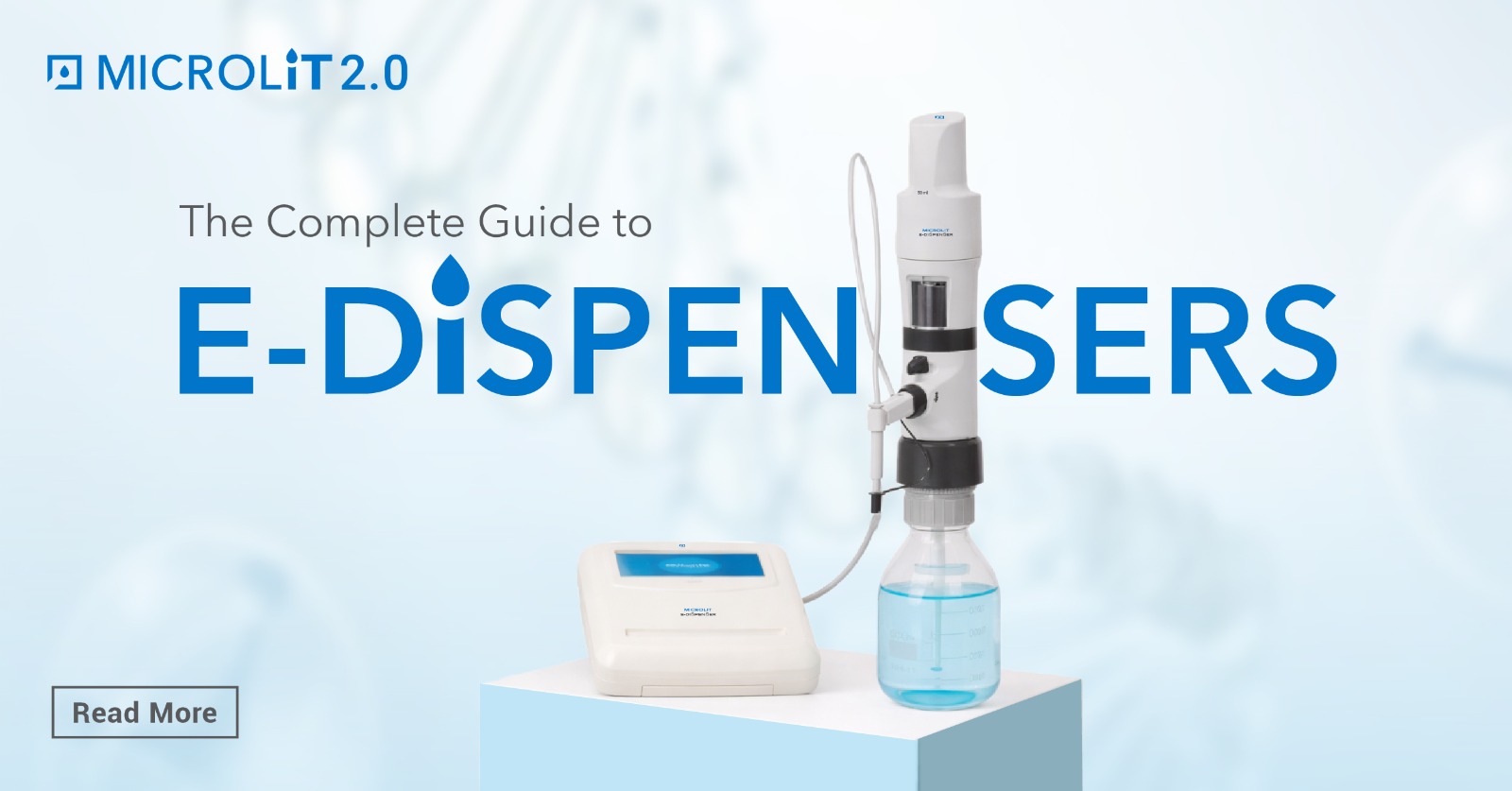
In modern laboratory environments, precision liquid handling is not merely a procedural requirement. It is the cornerstone of data integrity, reproducibility, and operational efficiency. As laboratories across pharmaceuticals, environmental monitoring, food & beverage testing, and life sciences scale their throughput demands, the instrumentation used for volumetric dispensing and titration must keep pace. Electronic dispensers have emerged as the definitive answer to that challenge.
In this blog, we will evaluate liquid handling solutions, offering a structured overview of what electronic dispensers are, how they compare to legacy instrumentation, and where they deliver the most measurable value.
A Brief Overview of E-Dispensers
An electronic dispenser is a motorised, microprocessor-controlled instrument designed for accurate, repeatable delivery of liquid volumes, typically spanning microliter to millilitre ranges. Unlike manual dispensers, which rely on user-applied mechanical force and are therefore inherently susceptible to operator variability, electronic dispensers employ a high-precision motor-controlled piston mechanism that standardises volume delivery across every cycle.
Advanced models such as the Microlit E-Dispenser extend this functionality further by incorporating electronic-burette capability, enabling the instrument to perform titration functions with the same metrological accuracy as traditional glass burettes while adding automated volume control and programmable dispensing modes.
Types of E-Dispensers
Understanding the operational taxonomy of electronic dispensers is essential before making a procurement decision. Broadly, they can be categorised by their dispensing mode architecture:
- Automated Dispensing Mode
The instrument delivers a pre-set volume upon a single trigger command. The mode is optimal for high-repetition workflows where consistent aliquot delivery is required, minimising both cycle time and manual intervention.
- Serial Dispensing Mode
The instrument sequentially dispenses a defined volume across multiple vessels in a single operation. Particularly valuable in sample preparation and dilution series workflows, serial mode substantially reduces pipetting steps and the absence and the associated cumulative error.
- Stepper Dispensing Mode
Volume is delivered in incremental steps, allowing the operator to dispense progressively and with granular control. This mode is well-suited to titration workflows and any application requiring fine volumetric resolution.
The Microlit E-Dispenser supports all three modes within a single platform, making it a versatile acquisition for laboratories that operate across varied analytical protocols.
Electronic Dispensers vs. Traditional Glass Burettes
The traditional glass burette has served analytical chemistry for over a century. However, its limitations in modern, high-throughput laboratory settings are increasingly difficult to overlook.
Manual burettes require the operator to visually estimate the meniscus, introducing subjective reading error. Volume adjustments are controlled entirely by hand, making fine incremental delivery difficult to reproduce across operators or shifts. There is also no data capture capability, meaning titration endpoints and volume readings must be recorded manually, creating additional risk of transcription error.
Electronic dispensers address each of these limitations systematically. The Microlit E-dispenser features a 4-inch TFT touchscreen that displays numeric data to the second decimal place, eliminating visual estimation entirely. Its motor-controlled piston delivers volume with tolerance levels that exceed industry standards, removing operator force as a variable. The memory function stores up to 20 readings locally in E-Burette mode, and optional portable printer integration allows documentation of up to 20 readings at once, complete with real-time date and time stamps.
For laboratories operating under GMP, GLP, or ISO quality frameworks, the shift from glass burettes to electronic dispensers is a meaningful improvement in data traceability and audit readiness.
Key Features of a High-Performance E-Dispenser
When evaluating electronic dispensers for procurement, the following feature criteria should be weighed carefully:
- Precision Motor Control
The piston drive mechanism is the core determinant of volumetric accuracy. Instruments should offer reproducibility that meets or exceeds pharmacopoeial and ISO standards.
- Multiple Dispensing Modes
A single instrument capable of automatic, serial, and stepper operation reduces the need for multiple devices across a laboratory’s workflow portfolio.
- Recirculation Mode
This function redirects reagents back into the mounted bottle during purging, eliminating reagent loss and ensuring bubble-free dispensing. It is particularly critical when working with expensive or hazardous reagents.
- Adjustable Nozzle Flexibility
The Microlit E-Dispenser’s FlexiNozzle® offers high degrees of movement in both horizontal and vertical planes, enabling dispensing into vessels of varying geometry without postural compromise of the operator.
- Touchscreen Interface
A stylus-operated TFT touchscreen allows precise input even when wearing gloves, which is a standard requirement in pharmaceutical and chemical environments.
- Memory & Documentation Capability
The ability to store, retrieve, and print dispensing records is non-negotiable in regulated industries.
- Chemical Compatibility Accessories
Instruments should accommodate reagent-specific requirements. The Microlit E-Dispenser, for instance, offers an amber-coloured acrylic window for light-sensitive reagents and a set of five adapters covering bottle thread sizes from 28mm to 45mm.
Industry Applications
The utility of electronic dispensers spans a broad range of regulated and research-intensive sectors:
- Pharmaceuticals
- Environmental Monitoring
- Food & Beverages
- Oil & Gas
- Life Sciences & Biotechnology
- Healthcare
- Agriculture
- Academic & Research Institutes
- Natural Resources
The Microlit E-Dispenser
Microlit has built its instrumentation portfolio on a philosophy of combining metrological precision with ergonomic intelligence. The E-Dispenser is a product of that ethos. Its dual functionality as both an electronic dispenser and an electronic burette means laboratories can consolidate two instrument categories into one, reducing capital expenditure and bench footprint simultaneously.
We have earned recognition through the Japanese Good Design Award, the CII Industrial Innovation Awards, and a place among the Top 50 Most Innovative Companies of 2022, alongside the Global Business Leadership Award from ET Now Leaders of Tomorrow 2025. These accolades reflect not only design quality but a sustained commitment to advancing liquid handling standards in laboratory sciences.
Closing Note
For lab managers and procurement leads assessing electronic dispensers, the evaluation framework should extend beyond unit cost to encompass accuracy specifications, dispensing mode versatility, chemical compatibility, and compliance support. The Microlit E-Dispenser addresses each of these criteria within a single, field-proven instrument.
To explore product specifications or discuss volume requirements, reach out to one of our experts for tailored guidance.