How to Select the Correct Pipette Volume Range A Complete Guide for Modern Laboratories
- July 16, 2026
- ENQUIRE NOW
Accurate liquid handling is the foundation of reliable laboratory results. Whether you’re performing molecular biology, pharmaceutical research, clinical diagnostics, food testing, or quality control, selecting the correct pipette volume range is just as important as choosing the right pipette itself.
Using the wrong volume range can lead to inaccurate measurements, poor repeatability, increased experimental errors, and unnecessary wear on your pipette. In this guide, we’ll explain how to choose the right pipette volume, common mistakes to avoid, and how modern mechanical and electronic pipettes can improve laboratory efficiency.
Why Does Pipette Volume Range Matter?
Every micropipette is designed to perform most accurately within its specified volume range. While many users tend to use one pipette for multiple applications, operating continuously at the extreme lower end of a pipette’s range can significantly reduce accuracy.
For example:
- Measuring 2 µL using a 20 µL pipette is less accurate than using a dedicated 2–10 µL pipette.
- Similarly, dispensing 900 µL is best performed using a 100–1000 µL pipette rather than stretching a smaller volume pipette.
Selecting the correct pipette ensures:
- Higher accuracy
- Better precision
- Improved repeatability
- Longer pipette lifespan
- Compliance with laboratory quality standards
Step 1: Identify Your Typical Working Volume
Before purchasing a pipette, identify the volume you dispense most frequently—not the occasional maximum volume.
Ask yourself:
- Do you mostly work with DNA or RNA samples?
- Are you preparing PCR reactions?
- Do you perform ELISA assays?
- Are you preparing buffers or media?
Your answers determine which volume range best suits your application.
Common Pipette Volume Ranges
|
Volume Range |
Typical Applications |
|
0.2–2 µL |
DNA sequencing, PCR setup |
|
0.5–10 µL |
Molecular biology |
|
2–20 µL |
qPCR, enzyme assays |
|
20–200 µL |
Cell culture, diagnostics |
|
100–1000 µL |
Buffer preparation, reagent dispensing |
|
1–5 mL |
Media preparation |
|
5–10 mL |
Large-volume liquid transfer |
Step 2: Choose the Smallest Suitable Pipette
A simple rule followed by experienced laboratory professionals is:
Always use the smallest pipette that comfortably covers your desired volume.
Example
If you need to dispense:
- 8 µL → Choose a 2–10 µL pipette
- 18 µL → Choose a 2–20 µL pipette
- 150 µL → Choose a 20–200 µL pipette
- 850 µL → Choose a 100–1000 µL pipette
This ensures better accuracy and minimizes percentage error.
Step 3: Consider the Type of Application
Different laboratory workflows require different pipetting styles.
Mechanical Pipettes
Mechanical pipettes remain the preferred choice for routine laboratory applications due to their simplicity, durability, and cost-effectiveness.
Applications include:
- Educational laboratories
- Clinical diagnostics
- Food testing
- Quality control
- Environmental testing
- Research laboratories
For laboratories seeking dependable mechanical pipettes, the MICROLIT NERO range offers ergonomic single-channel pipettes designed for everyday precision and comfort.
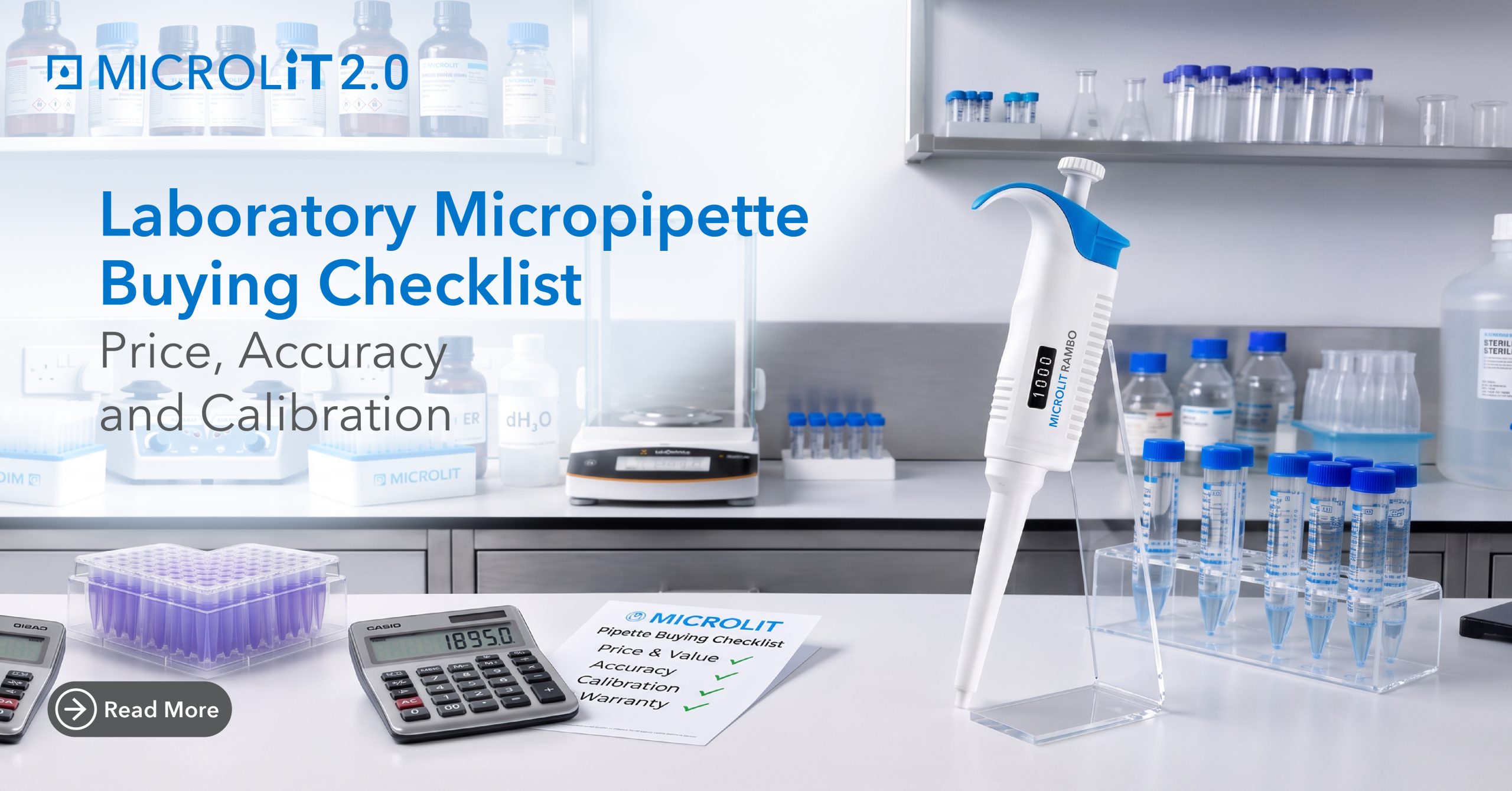
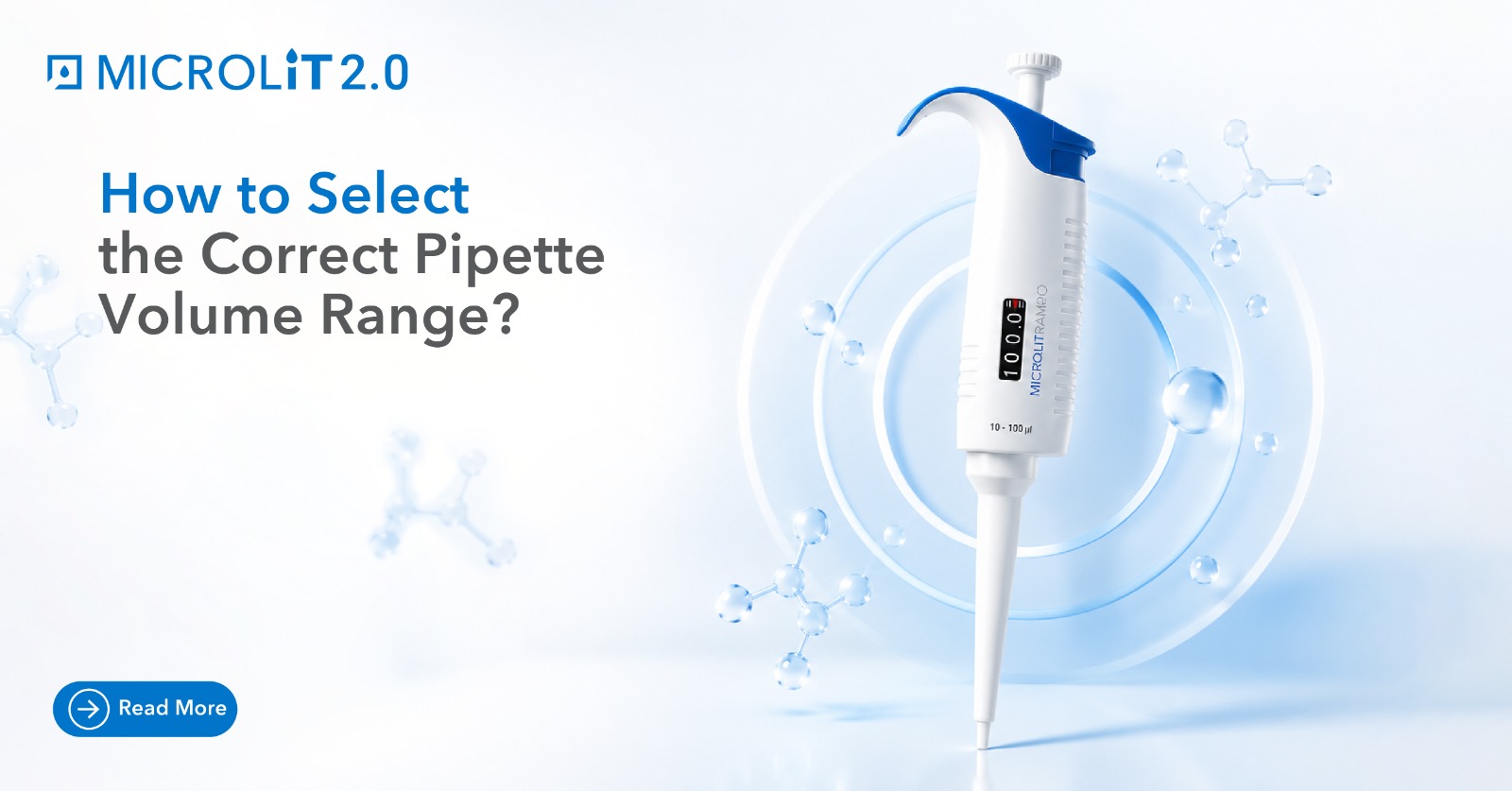
When higher throughput is required, such as filling PCR plates, ELISA plates, or 96-well microplates, MICROLIT RAMBO multichannel pipettes help improve productivity while maintaining consistent accuracy across multiple channels.
Explore:
- MICROLIT NERO Mechanical Micropipettes: https://www.microlit.com/product-category/nero-micropipette/
- MICROLIT RAMBO Multichannel Micropipettes: https://www.microlit.com/product-category/rambo-micropipette/
Electronic Pipettes
Electronic pipettes are ideal when laboratories require higher precision, reduced manual effort, and repetitive dispensing.
They are particularly useful for:
- High-throughput laboratories
- Pharmaceutical R&D
- Biotechnology
- Molecular biology
- Clinical diagnostics
- Vaccine research
The MICROLIT AQUA Electronic Pipette combines advanced electronic control with multiple pipetting modes, programmable workflows, adjustable dispensing speeds, and an intuitive color display, making repetitive liquid handling faster and more ergonomic.
Explore the MICROLIT AQUA range:
https://www.microlit.com/product-category/aqua-electronic-micropipette/
Step 4: Think About Frequency of Use
How often will the pipette be used?
If you perform hundreds of pipetting cycles every day, an ergonomic pipette becomes essential.
Look for features like:
- Lightweight construction
- Low plunger force
- Comfortable finger hook
- Easy volume adjustment
- Reduced thumb fatigue
Electronic pipettes further reduce repetitive strain by automating aspiration and dispensing.
Step 5: Match Pipette with Compatible Tips
Even the most accurate pipette cannot perform well with poorly fitting tips.
Proper tip compatibility ensures:
- Leak-free sealing
- Consistent aspiration
- Accurate dispensing
- Better reproducibility
High-quality universal tips, such as MICROLIT Pipette Tips, are engineered for secure fitting and reliable liquid transfer across compatible pipette brands.
Common Mistakes When Choosing a Pipette
Using One Pipette for Every Volume
Many laboratories rely heavily on one pipette covering a broad range.
While convenient, this often reduces measurement accuracy at very low volumes.
Frequently Working at Maximum Capacity
Dispensing near the maximum volume continuously may reduce long-term performance.
Choose a pipette whose normal operating volume falls comfortably within its working range.
Ignoring Future Applications
Laboratory requirements evolve.
Consider whether your future projects may require:
- PCR
- Cell culture
- ELISA
- Molecular biology
- Large-volume reagent preparation
Selecting a versatile pipette range helps accommodate future needs.
Mechanical or Electronic: Which Should You Choose?
Choose a mechanical pipette if you:
- Perform routine liquid transfers
- Need a cost-effective solution
- Require reliable day-to-day performance
- Prefer simple operation
Choose an electronic pipette if you:
- Pipette for several hours daily
- Perform repetitive dispensing
- Require multiple pipetting modes
- Want programmable workflows
- Need higher productivity
Many laboratories maintain both mechanical and electronic pipettes to optimize efficiency across different applications.
Selecting the Right Volume Range by Laboratory Type
Molecular Biology
Recommended:
- 0.5–10 µL
- 2–20 µL
- Electronic pipettes for repetitive PCR preparation
Clinical Diagnostics
Recommended:
- 20–200 µL
- 100–1000 µL
Pharmaceutical Laboratories
Recommended:
- Complete pipette range from 2 µL to 1000 µL
- Electronic pipettes for repetitive dispensing
Food & Environmental Testing
Recommended:
- 100–1000 µL
- Mechanical pipettes for routine testing
Selecting the correct pipette volume range is one of the simplest yet most effective ways to improve laboratory accuracy, efficiency, and reproducibility. By matching the pipette to your typical working volume, application type, and workflow, you can reduce errors, improve user comfort, and extend instrument life.
For routine laboratory work, ergonomic mechanical pipettes such as the MICROLIT NERO provide dependable precision, while MICROLIT RAMBO multichannel pipettes enhance productivity in plate-based workflows. Laboratories seeking advanced functionality and effortless repetitive dispensing can benefit from the MICROLIT AQUA electronic pipette range.
Choosing the right pipette isn’t just about transferring liquid—it’s about ensuring confidence in every experiment.