Essential Pipettes for Molecular Biology Laboratories in India
- August 10, 2026
- ENQUIRE NOW
Molecular biology laboratories rely on precise and consistent liquid handling at almost every stage of research. From DNA and RNA preparation to PCR, sequencing, cell culture and diagnostic workflows, transferring even a few microlitres accurately can influence experimental outcomes.
This makes selecting the right laboratory pipettes in India an important decision for research institutes, universities, biotechnology companies, pharmaceutical laboratories and diagnostic facilities.
With several micropipette manufacturers in India and international brands available in the market, laboratories today have a wide range of options. But which pipettes are essential for a molecular biology laboratory? And how should researchers select the right combination?
This guide explores the key types of pipettes and the factors laboratories should consider when building an efficient liquid handling setup.
Why Pipettes Matter in Molecular Biology
Molecular biology workflows frequently involve small volumes of samples, buffers, enzymes, primers and reagents. A small variation in volume can change reagent concentrations and potentially affect downstream results.
Reliable pipetting helps laboratories achieve:
- Consistent reagent concentrations
- Improved experimental reproducibility
- Accurate sample preparation
- Reduced contamination risks
- Better workflow efficiency
- Lower reagent wastage
Therefore, selecting laboratory pipettes in India should not be based solely on price. Accuracy, precision, ergonomics, calibration, tip compatibility, durability and service support are equally important.
-
Single-Channel Micropipettes
A single-channel micropipette is one of the most essential tools in a molecular biology laboratory.
These pipettes are designed to transfer liquid into or out of individual tubes, wells and containers. They are commonly used for sample preparation, reagent transfer, DNA and RNA handling, PCR setup and general laboratory procedures.
Most laboratories require several single-channel pipettes covering different volume ranges rather than relying on one pipette for every application.
For example, a laboratory may maintain separate pipettes for low-volume transfers, routine mid-volume operations and larger liquid transfers.
When comparing micropipettes in India, laboratories should select volume ranges according to their actual workflows.
-
Multichannel Micropipettes
When molecular biology workflows involve microplates or multiple samples, multichannel pipettes can significantly improve productivity.
Instead of transferring liquid into individual wells one at a time, a multichannel pipette can transfer liquid across several wells simultaneously.
They are particularly useful for:
- PCR and qPCR plate preparation
- ELISA
- Microplate assays
- Sample dilution
- High-throughput screening
- Reagent distribution
For laboratories processing dozens or hundreds of samples, multichannel pipettes can reduce repetitive operations and improve consistency.
Both manual and electronic multichannel options are available, allowing laboratories to select a solution based on throughput and workflow complexity.
-
Electronic Micropipettes
Electronic micropipettes are increasingly being adopted by laboratories that require greater control, repeatability and convenience.
Unlike conventional mechanical pipettes, electronic models use a motor-driven mechanism for aspiration and dispensing. Depending on the model, users can access multiple operating modes and programmable functions.
Electronic pipettes can be particularly useful for:
- Repetitive pipetting
- Serial dispensing
- Microplate preparation
- High-throughput applications
- Long-duration pipetting workflows
For laboratories looking to reduce repetitive manual effort, electronic pipettes can complement traditional mechanical micropipettes.
For example, MICROLIT AQUA is a multifunctional electronic micropipette designed for laboratory liquid handling, with single-channel and multichannel configurations.
-
Fixed-Volume Pipettes
Fixed-volume pipettes are designed to dispense a predetermined volume.
They can be useful when a laboratory repeatedly performs a specific procedure requiring the same volume. Since the volume does not need to be adjusted for every transfer, they can simplify repetitive workflows.
Fixed-volume pipettes can be particularly useful in standardised laboratory protocols where consistency and speed are priorities.
When selecting pipettes in India, laboratories should assess whether fixed-volume models can improve efficiency for their most repetitive procedures.
-
Variable-Volume Micropipettes
Variable-volume micropipettes provide flexibility by allowing users to select different volumes within the pipette’s specified operating range.
These are among the most commonly used pipettes in molecular biology laboratories because a single pipette can support multiple procedures.
They are useful for:
- DNA and RNA sample preparation
- PCR setup
- Buffer preparation
- Enzyme handling
- Sample transfer
- General molecular biology workflows
However, users should avoid operating a pipette at the extreme ends of its range when another pipette with a more appropriate volume range is available.
-
Pipettes for DNA and RNA Workflows
DNA and RNA workflows require careful liquid handling because samples and reagents are often available in small quantities.
For DNA extraction, purification and PCR preparation, laboratories may require several micropipettes covering low, medium and higher volume ranges.
RNA workflows require additional attention to contamination control because RNA is susceptible to degradation by RNases.
For these applications, laboratories should consider:
- Appropriate volume ranges
- Filter tips where required
- RNase-free consumables for RNA workflows
- Reliable tip fit
- Consistent pipetting technique
- Regular calibration and maintenance
A good combination of micropipettes in India can help laboratories establish consistent workflows from sample preparation through downstream analysis.
-
Adjustable Multichannel Pipettes
Adjustable-spacing multichannel pipettes offer additional flexibility when working with different plate formats or tube configurations.
Instead of being limited to a fixed spacing, the user can adjust the distance between tips according to the application.
This can be particularly useful for laboratories working with different microplates, tubes and sample containers.
For molecular biology laboratories with diverse workflows, adjustable multichannel pipettes can reduce the need for multiple specialised instruments.
-
Repeater and Repetitive Dispensing Pipettes
Some molecular biology workflows involve dispensing the same volume repeatedly into multiple tubes or wells.
Repeating pipettes or dispensing systems can make these tasks faster and more consistent than performing individual aspiration and dispensing cycles.
They can be useful for:
- Reagent distribution
- Plate filling
- Serial dispensing
- Sample aliquoting
- High-volume repetitive workflows
The appropriate solution depends on the required volume, number of dispensing cycles and workflow design.
-
What Should Indian Laboratories Consider When Buying Pipettes?
The growing number of micropipette manufacturers in India gives laboratories more choice, but it also makes product evaluation important.
Before purchasing, consider the following:
Accuracy and Precision
Check the manufacturer’s stated accuracy and precision specifications for the volume range you use.
Ergonomics
A pipette should be comfortable for repetitive operation. Weight, grip, plunger force and tip-ejection force can all influence user experience.
Calibration
Choose pipettes that can be calibrated and maintained according to applicable laboratory requirements.
Tip Compatibility
Check whether compatible tips are readily available and whether the laboratory can standardise consumables across multiple pipette models.
Service and Support
Local service availability can reduce downtime and simplify maintenance.
Total Cost of Ownership
Consider not just the purchase price but also tips, calibration, maintenance, spare parts and expected product life.
Choosing Laboratory Pipette Suppliers in India
Selecting the right equipment is only part of the purchasing process. Choosing reliable laboratory pipette suppliers in India is equally important.
A dependable supplier should ideally provide:
- Genuine laboratory products
- Product documentation
- Calibration and service support
- Spare parts availability
- Technical assistance
- Appropriate consumables
- Consistent after-sales support
For laboratories operating under quality systems, documentation and traceability can also be important considerations.
Researchers should evaluate suppliers based on their ability to support the pipette throughout its lifecycle rather than simply offering the lowest initial price.
MICROLIT: An Indian Liquid Handling Solution
Among the micropipette manufacturers in India, MICROLIT has developed a broad liquid handling portfolio for laboratories across research, pharmaceutical, biotechnology, healthcare, academic and industrial applications.
Its micropipette portfolio includes mechanical and electronic solutions designed for different laboratory workflows.
MICROLIT NERO incorporates patented UniCal® Technology, designed to simplify micropipette calibration and adjustment. This provides laboratories with a practical approach to maintaining pipette performance.
MICROLIT AQUA is a multifunctional electronic micropipette designed for advanced liquid handling workflows, with single-channel and multichannel configurations.
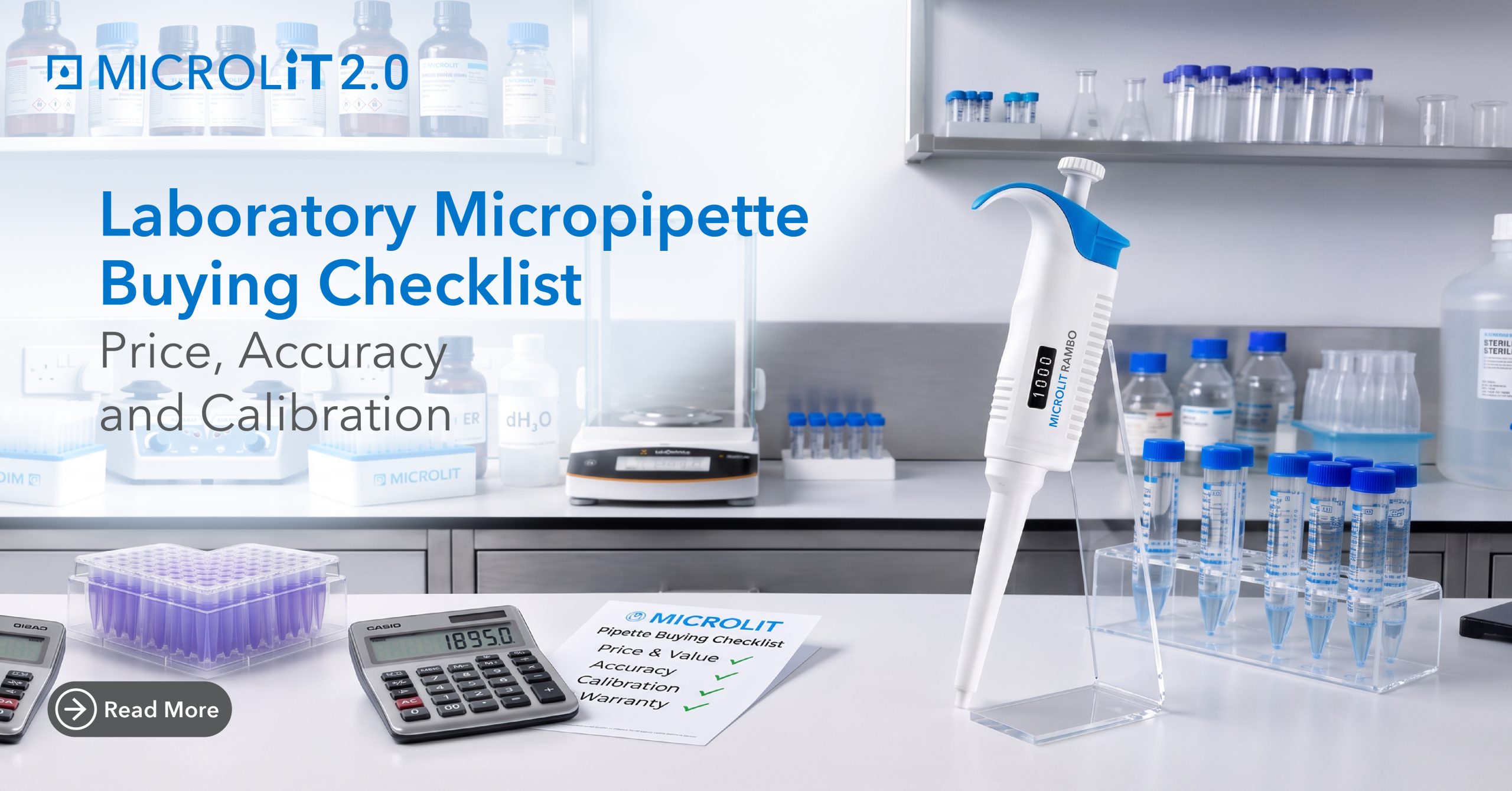
MICROLIT also offers RAMBO mechanical micropipettes, giving laboratories additional options for routine liquid handling applications.
Together, these solutions demonstrate how modern laboratory pipettes in India are evolving beyond conventional manual pipetting to address precision, productivity, ergonomics and maintenance requirements.
Building the Right Pipette Portfolio
A molecular biology laboratory rarely needs just one type of pipette.
A well-planned liquid handling setup may include:
- Low-volume single-channel micropipettes
- Medium- and higher-volume micropipettes
- Multichannel pipettes
- Electronic micropipettes
- Fixed-volume pipettes for repetitive procedures
- Repetitive dispensing solutions
- Appropriate pipette tips and consumables
The exact combination depends on the laboratory’s applications, sample volumes, throughput and quality requirements.
Instead of buying pipettes individually as needs arise, laboratories can assess their complete workflow and create a balanced pipette portfolio.
What Next?
From DNA extraction and PCR to sequencing, diagnostics and high-throughput screening, pipettes are fundamental to molecular biology laboratories.
The availability of multiple micropipette manufacturers in India, laboratory pipette suppliers in India and international brands means researchers have more choices than ever when selecting liquid handling equipment.
The key is to look beyond the brand or purchase price. Evaluate accuracy, precision, volume range, ergonomics, calibration, tip compatibility, application suitability, service support and total cost of ownership.
Whether you are establishing a new laboratory or upgrading an existing one, selecting the right combination of pipettes in India, laboratory pipettes in India and micropipettes in India can help create a more reliable, efficient and reproducible molecular biology workflow.
Ultimately, the right pipette is not simply a laboratory instrument—it is an essential part of the experimental process.