Pipette Accuracy & Precision – What Is the Difference?
- October 28, 2026
- ENQUIRE NOW
Pipettes are among the most frequently used instruments in laboratories, playing a critical role in transferring precise volumes of liquids. From pharmaceutical research and clinical diagnostics to biotechnology, molecular biology, chemistry and academic laboratories, reliable pipetting can directly influence the quality and reproducibility of experimental results.
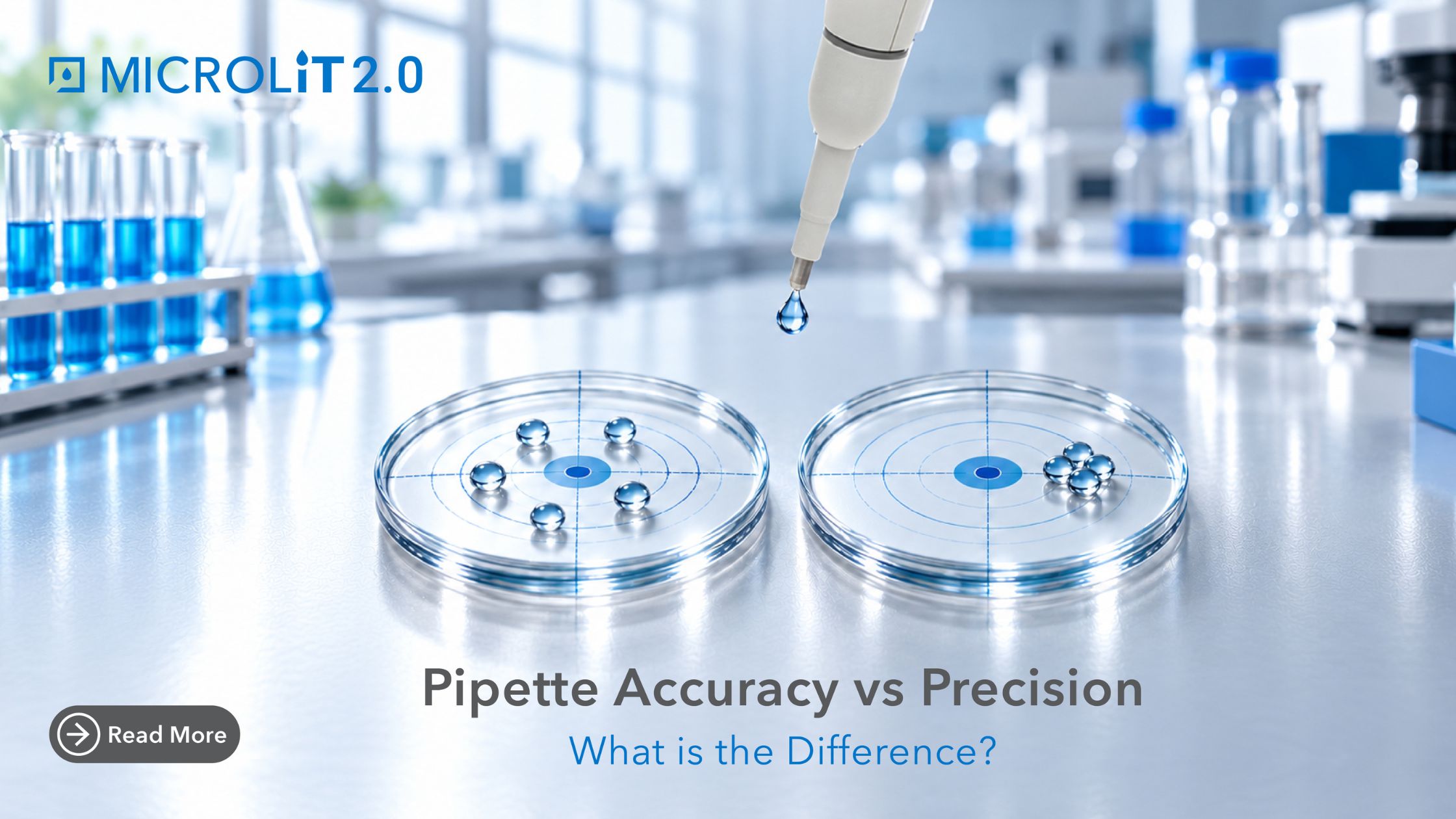
Two terms frequently associated with pipette performance are accuracy and precision. Although they are often used interchangeably, they describe two different aspects of pipetting performance.
Understanding the difference between pipette accuracy and precision can help laboratory professionals identify pipetting errors, select suitable instruments, establish appropriate calibration practices, and improve the reliability of their experiments.
What Is Pipette Accuracy?
Accuracy refers to how close the dispensed volume is to the intended or set volume.
For example, suppose a pipette is set to dispense 100 µL. If the actual measured volume is 99.8 µL, the result is very close to the target value and therefore demonstrates good accuracy.
However, if the pipette consistently dispenses around 95 µL when set at 100 µL, it has poor accuracy because the delivered volume differs significantly from the intended volume.
Accuracy is primarily associated with systematic error. A systematic error repeatedly shifts measurements in the same direction, causing the pipette to consistently deliver either more or less than the target volume.
In simple terms:
High accuracy = Delivered volume is close to the target volume.
Several factors may affect pipette accuracy, including incorrect calibration, worn or damaged components, improper tip fitting, environmental conditions, liquid properties, and incorrect pipetting techniques.
What Is Pipette Precision?
Precision refers to how closely repeated pipetting measurements agree with one another.
Imagine that a pipette is set to 100 µL and used repeatedly. If the measured volumes are 99.7, 99.8, 99.7, 99.9, and 99.8 µL, the results demonstrate good precision because there is very little variation between measurements.
Now consider another situation where the results vary significantly—for example, 94 µL, 103 µL, 98 µL, 105 µL, and 96 µL. Even if the average happens to be close to 100 µL, the pipette demonstrates poor precision because individual measurements are inconsistent.
Precision is commonly associated with random error, which causes unpredictable variation among repeated measurements.
In simple terms:
High precision = Repeated measurements are close to each other.
Accuracy vs. Precision: What Is the Key Difference?
The easiest way to understand the distinction is:
Accuracy asks: “How close are we to the correct value?”
Precision asks: “How consistent are the results?”
Consider a pipette set at 100 µL.
If repeated measurements are 100.1, 99.9, 100.0, 100.1, and 99.9 µL, the pipette demonstrates both high accuracy and high precision.
If the results are 95.1, 95.0, 95.2, 95.1, and 95.0 µL, they are highly consistent, meaning the pipette has good precision. However, because the results are consistently far from the 100 µL target, its accuracy is poor.
Similarly, measurements scattered around the target value may have acceptable average accuracy but poor precision.
Therefore, a reliable pipette should ideally demonstrate both accuracy and precision.
Why Are Accuracy and Precision Important?
Even small variations in transferred liquid volumes can influence laboratory results, particularly when working with microlitre quantities.
For example, inaccurate pipetting during PCR preparation can alter reagent concentrations. In cell culture applications, incorrect volumes may affect media composition or experimental conditions. In pharmaceutical and analytical laboratories, volume errors can influence sample preparation and ultimately affect analytical results.
Reliable pipetting supports:
- Reproducibility of experiments
- Consistency between operators and laboratories
- Reliable sample and reagent preparation
- Reduced reagent wastage
- Improved confidence in experimental data
- Better compliance with laboratory quality procedures
For laboratories performing critical quantitative work, accuracy and precision are therefore essential performance characteristics.
What Can Affect Pipette Accuracy and Precision?
Even a well-designed and properly calibrated pipette can produce inconsistent results when it is used incorrectly.
Pipetting technique is one of the most important factors. Inconsistent aspiration speed, incorrect pipette angles, incomplete dispensing, or variations in immersion depth can influence transferred volumes.
Pipette tips also matter. Poorly fitting or incompatible tips can create an inadequate seal, potentially causing leakage or inconsistent aspiration.
Temperature differences between the pipette, liquid, tips, and surrounding environment can influence liquid-handling performance. This is particularly important during gravimetric testing.
The physical properties of liquids should also be considered. Highly viscous, volatile, foaming, or dense liquids may require modified pipetting techniques compared with water-based solutions.
Finally, maintenance and calibration are essential. Seals, pistons, O-rings, and other internal components can experience wear over time, potentially affecting pipette performance.
How Are Pipette Accuracy and Precision Evaluated?
One commonly used method for evaluating piston-operated volumetric apparatus is gravimetric testing.
During this process, a pipette dispenses a defined volume of water into a suitable weighing vessel. The mass of the dispensed water is measured using a calibrated balance and converted into volume while considering appropriate environmental and water-density factors.
Multiple measurements are performed to assess both systematic and random errors.
The systematic error provides information related to accuracy, while the random error reflects the repeatability or precision of the pipette.
Laboratories should follow applicable procedures and standards, including relevant requirements of ISO 8655, when evaluating pipette performance.
Tips for Improving Pipetting Accuracy and Precision
Good pipetting practices can significantly improve liquid-handling performance.
Before beginning, ensure that the pipette and tips are appropriate for the required volume range and application. Fit the tip correctly to achieve a reliable seal and pre-wet the tip when appropriate.
During aspiration, keep the pipette as vertical as practical and immerse the tip only to the recommended depth. Aspirate smoothly and consistently rather than releasing the plunger abruptly.
When dispensing, maintain a consistent technique and ensure that the complete intended volume is delivered. Avoid unnecessary warming of the pipette through prolonged handling, particularly during sensitive measurements.
Regular cleaning, maintenance, performance checks, and calibration should also form part of the laboratory’s pipette management program.
Microlit Pipettes for Accurate and Precise Liquid Handling
Choosing the right pipette is an important step toward achieving reliable liquid-handling results. Microlit offers a comprehensive range of mechanical and electronic micropipettes designed for different laboratory workflows.
The Microlit NERO® range includes single-channel fixed-volume, single-channel variable-volume, and multichannel variable-volume micropipettes. NERO® incorporates UniCal® calibration technology along with μAir® technology and is designed for accurate and precise routine laboratory pipetting.
The Microlit RAMBO range provides ergonomic mechanical micropipetting options in single-channel and multichannel configurations, making it suitable for a broad range of routine laboratory liquid-handling applications.
For laboratories looking for electronic liquid handling, the Microlit AQUA range includes multifunctional electronic single-channel pipettes, 8- and 12-channel electronic pipettes, and adjustable/variable-spacing multichannel electronic pipettes in 4-, 6-, 8-, and 12-channel configurations.
Together, these options allow laboratories to select a pipette according to the required volume, throughput, application, workflow, and level of automation.
Explore the complete range of Microlit Micropipettes.
Conclusion
Accuracy and precision are closely related, but they are not the same.
Accuracy describes how close a pipetted volume is to the intended value, while precision describes how consistently that volume can be reproduced.
A pipette can be precise without being accurate, and an average result can appear accurate even when individual measurements lack precision. For dependable laboratory work, both characteristics need to be controlled.
Choosing an appropriate pipette, following correct pipetting techniques, using suitable tips, performing regular maintenance, and maintaining an appropriate calibration program can help laboratories achieve more reliable liquid transfers.
With mechanical and electronic options across its NERO®, RAMBO, and AQUA ranges, Microlit offers pipetting solutions for diverse laboratory requirements where accuracy, precision, ergonomics, and reproducibility matter.
Ultimately, accurate and precise pipetting contributes to something even more important: reliable, reproducible, and trustworthy laboratory results.