Role of Electronic Burettes in Pharmaceutical Laboratories
- June 12, 2026
- ENQUIRE NOW

In pharmaceutical laboratories, titration is not a routine analytical exercise. It is a validated, regulated, and documentation-intensive process that directly underpins potency determination, raw material qualification, pH adjustment verification, and a range of USP and pharmacopoeial assays. The instruments used to execute these titrations carry direct accountability for the reliability of results that drive batch release decisions, NDA submissions, and ultimately, patient safety outcomes. Against that backdrop, the continued use of manual glass burettes in pharmaceutical QC and R&D environments represents a measurable and largely avoidable source of analytical risk.
Electronic burettes have redefined what precision and compliance look like at the titration bench. This blog examines why pharmaceutical laboratories are making the transition, and what the Microlit E-Burette brings to that equation.
The Problem with Manual Titration in a Regulated Environment
Manual burettes place the entire burden of volumetric accuracy on the operator. Meniscus reading, flow rate control, endpoint identification, and result transcription are all human-dependent steps, each carrying its own error contribution. In potency assays for active pharmaceutical ingredients, where a volumetric error of even 0.1 ml can translate into a reportable out-of-specification result, this dependency is not a theoretical concern. It is a documented source of laboratory investigations, repeat analyses, and in some cases, batch rejections.
Across multi-analyst QC environments, shift-based operations, and multi-site method transfers, the inter-analyst variability introduced by manual technique compounds into a systemic reproducibility problem. Pharmaceutical laboratories operating under cGMP, GLP, and USP General Chapter frameworks are required to demonstrate method reproducibility as a validation deliverable. A pharmaceutical laboratory burette that cannot deliver consistent volumetric output independent of operator technique introduces a structural gap in that demonstration.
Fun Fact: The burette was invented in the mid-19th century, but it was Gay-Lussac who is widely credited with early volumetric analysis methods that laid the groundwork for burette-based titration. For nearly 150 years after its invention, essentially nothing changed about how a burette worked. It took electromechanical engineering in the late 20th century to finally move the needle, literally.
Quick Set Feature
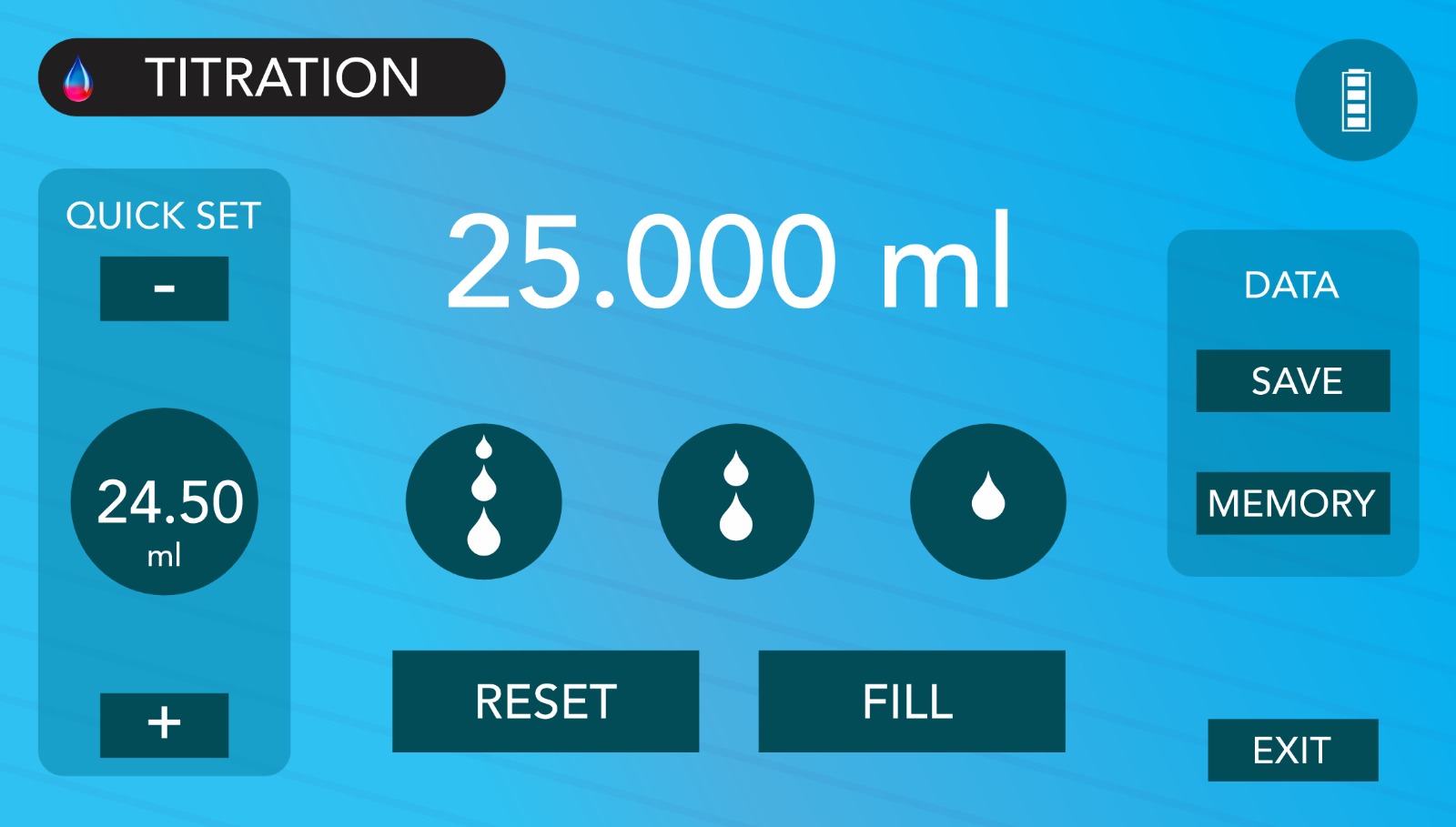
One of the friction points in high-frequency pharmaceutical titration workflows is the manual volume re-entry required between successive titration runs. In QC environments where the same method is executed across multiple samples in a single session, repeated manual adjustment introduces both time inefficiency and the risk of input error between runs.
The Microlit E-Burette’s Quick Set feature eliminates this step entirely. It automatically dispenses the last saved volume upon activation, removing the need for manual parameter re-entry between consecutive titrations. For laboratories running batch sample sets against a single standardized method, this means the analyst moves directly from one titration to the next without interrupting workflow to reset the instrument. Across a full QC session involving ten, twenty, or more samples, the cumulative time saving and the elimination of inter-run input variability are both operationally meaningful.
Portable Printer Integration
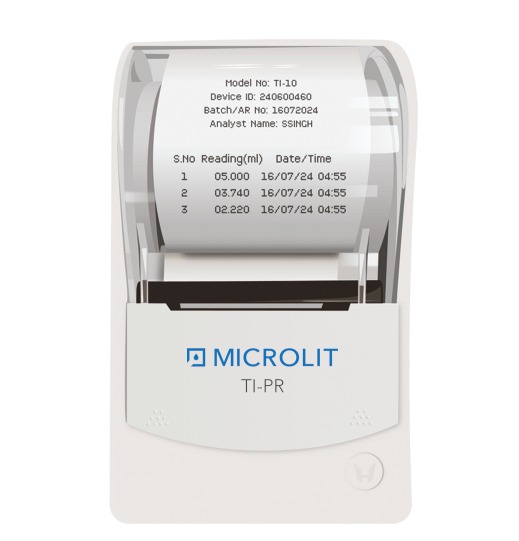
In regulated pharmaceutical environments, documentation is not a post-analytical step. It is an integral part of the analytical process itself. Manual transcription of titration results from a digital display into a laboratory notebook or LIMS entry field introduces a transcription error risk that sits outside the instrument’s validated performance envelope and entirely within the operator’s.
The Microlit E-Burette’s portable printer integration addresses this directly. The system supports printing of up to 20 readings at once, each record stamped with real-time date and time data, generating a contemporaneous hard-copy record at the point of analysis rather than relying on manual transfer. For pharmaceutical laboratories where raw data integrity is subject to FDA or ICH Q10 audit scrutiny, this capability provides a secondary documentation layer that is both traceable and tamper-evident.
In environments where paper backup remains a procedural or site-specific requirement alongside electronic record systems, the integration removes the documentation gap between instrument output and audit-ready record without adding a separate manual step to the analytical workflow
Motor-Controlled Piston Movement: Removing the Operator Variable
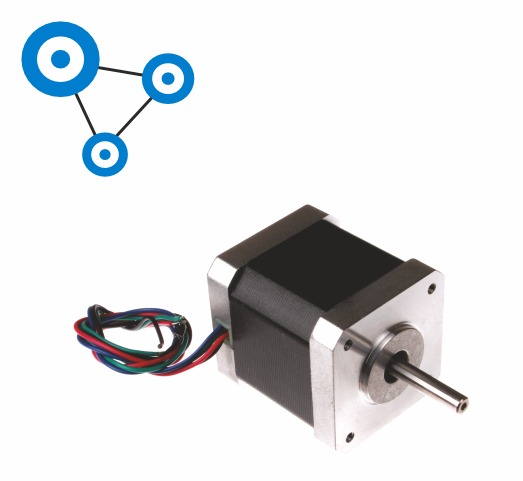
The foundational advantage of an electronic titration system over its manual counterpart is the replacement of hand-controlled reagent delivery with motor-controlled piston movement. In pharmaceutical QC workflows, this distinction is operationally significant. Karl Fischer titrations for moisture determination, perchloric acid titrations for alkaloid assays, and argentometric titrations for halide quantification all require a level of dispensing control that manual wheel operation cannot consistently deliver across analysts or across time.
The Microlit E-Burette’s motor-controlled piston standardises flow rate, dispensing pressure, and incremental volume delivery across every titration cycle. Two analysts running the same USP-compendial method on the same instrument will produce results that reflect the chemistry of the reaction rather than the technique of the individual. For pharmaceutical laboratories where method transfer between QC sites or contract testing organisations is a routine validation activity, this is not an incremental gain. It is a foundational one.
Three-Speed Recalibration and Titration Precision
Pharmaceutical titrations span a wide range of endpoint sensitivity requirements, and a single dispensing speed is an inadequate response to that variability. Acid-base titrations for API potency determination, with their characteristically sharp equivalence points, demand rapid bulk delivery followed by precise dropwise control in the endpoint approach zone. Complexometric titrations for metal ion quantification and redox titrations for oxidant or reductant assay present more gradual endpoint transitions, where fine volumetric resolution across a wider dispensing range is the controlling precision requirement.
The Microlit E-Burette’s three calibrated pre-set speeds, fast, medium, and dropwise, each independently recalibratable, allow the instrument to be configured to the specific titration method rather than adjusted to a compromise setting. The dropwise speed is particularly critical in endpoint approach, where volume increments in the sub-0.05 ml range determine whether the equivalence point is captured within reportable tolerance or overshot into an out-of-specification result. The TFT touchscreen displays numeric data to the second decimal place, and the stylus-operated interface provides real-time dispensing control with instant stop on stylus release, enabling the analyst to manage the endpoint approach with the precision that compendial methods require.
Fun Fact: The concept of the endpoint in titration was so difficult to detect visually in early analytical chemistry that chemists would often overshoot it and work backwards mathematically. The introduction of pH indicators in the late 19th century was considered a major breakthrough, roughly equivalent to what electronic control systems represent today.
Recirculation Mode and Reagent Economy
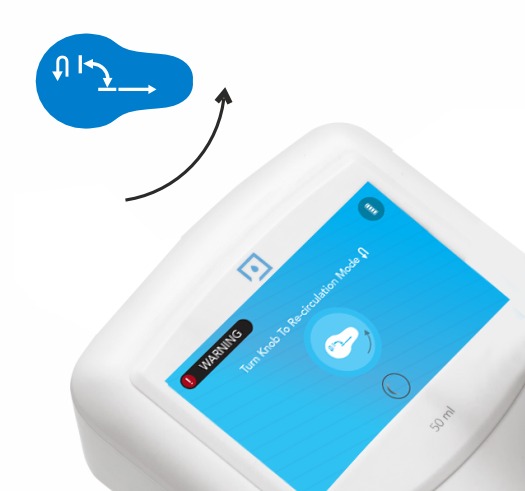
In pharmaceutical QC laboratories, titrant solutions are prepared, standardised, and assigned expiry windows under strict change control. Reagent loss during instrument priming is therefore not merely a cost concern. It is a traceability issue, particularly when standardised titrant consumed during purging must be accounted for in reagent usage logs or when freshly prepared solutions are purged before their initial standardisation factor has been confirmed.
The Microlit E-Burette’s recirculation mode redirects reagents back into the mounted bottle during the purging cycle rather than expelling them to waste. For laboratories running high titration volumes with expensive titrants such as cerium sulfate, potassium permanganate, or EDTA solutions prepared to tight concentration specifications, the cumulative reagent economy across a working week is measurable. Bubble-free dispensing is a parallel benefit, eliminating the volume uncertainty that trapped air introduces into the delivery column during critical titration steps.
Compliance Architecture: ISO 8655, GLP, and 21 CFR Part 11
For pharmaceutical laboratory managers, the compliance credentials of an instrument are often the deciding procurement criterion. The Microlit E-Burette is engineered to satisfy the documentation, calibration, and data integrity requirements of regulated pharmaceutical environments across multiple compliance frameworks.
-
ISO 8655 Conformance
The E-Burette conforms to ISO 8655 standards for piston-operated volumetric apparatus, ensuring that volumetric accuracy and reproducibility meet internationally recognised metrological benchmarks.
-
GLP Compliance
Each unit is individually calibrated and supplied with a calibration certificate, satisfying the instrument qualification documentation requirements of Good Laboratory Practice frameworks. In-laboratory electronic recalibration is supported without the requirement for external calibration tooling, reducing the logistical burden of periodic recalibration cycles.
-
FDA 21 CFR Part 11 Compliant Software
The E-Burette software extends the compliance architecture into the data layer. Developed in conformance with FDA 21 CFR Part 11, it enables simultaneous electronic record creation during titration, with automatic computation of molarity and normality from input parameters and titration readings.
-
Multi-Step Authentication
A multi-step authentication process governs software access, ensuring that only permitted users can operate the system and retrieve stored data.
-
Audit Trail
Every user action from login to experiment creation is captured in a secure, tamper-evident audit trail accessible only to permitted users, satisfying traceability requirements without manual logging.
-
Data Integrity and Non-Editability
Once recorded, titration data cannot be edited, satisfying the non-repudiation requirements of 21 CFR Part 11 without requiring manual data locking protocols. Microlit has no access to data stored on a laboratory’s instance of the software, ensuring complete organisational data ownership.
Available Volumes and Chemical Compatibility
The Microlit E-Burette is available in three capacities: 10 ml, 25 ml, and 50 ml, directly mapping to the volume ranges specified across the most commonly referenced USP and pharmacopoeial titration methods. The 10 ml configuration supports micro-scale titrations where analyte quantity is limited, such as in early-phase API characterisation or high-potency compound assays where sample mass is deliberately minimised. The 25 ml and 50 ml configurations address standard QC titration volumes for raw material qualification, finished product release testing, and stability sample analysis.
The amber-coloured window accessory accommodates light-sensitive titrants including iodometric solutions and photodegradable indicators without requiring secondary light-exclusion measures. Five bottle adapters covering thread sizes from 28 mm to 45 mm ensure compatibility across the reagent bottle formats most common in US pharmaceutical laboratory supply chains.
Make the Switch to Compliant, Precise Titration
Electronic burettes in pharmaceutical laboratories are no longer a premium upgrade over manual instrumentation. They are the appropriate baseline for any laboratory where titration results feed into regulated decisions. The Microlit E-Burette, backed by ISO 8655 conformance, GLP compliance, and 21 CFR Part 11 software integration, is built specifically for that standard.
To request product specifications, calibration documentation, or a demonstration, contact the Microlit team at info-usa@microlit.com